

Introducing System One Models & Jev
介绍 System One 模型与 Jev
2,106 个英文词 · 9 个原文块 · 4 张保存图片 · 原文与完整中文译文对照 · 原图保留

总结
TypeSafe用Jev探索另一种模型接口:输入状态和有类型的问题,输出可被程序直接使用的概率决策。本文保留英文原文、校订中文译文、对比表格和4张图片。
重点辨别类型保证与事实正确性的差别,以及厂商速度/成本倍数采用的评测条件。视频保留原站入口,FAQ按保存时的展开范围呈现。
- 结构化决策
- 类型安全
- 概率校准
- 工作流评估
- Jev
英文原文 01
235 词 · 1 张图
Diogo Almeida, founder, TypeSafe
Models have been superhuman at chat for years, so where is all the automation?
This has been my driving question for the last four years. At OpenAI, I helped build the methods that made language models useful at following instructions and talking with people. That work ended up as the research behind ChatGPT. At the time, I thought maybe chat models would lead to AGI, but despite the hype it became obvious to me that there was something really big missing.
After two years in stealth, countless technical challenges, and research breakthroughs… I am beyond excited to announce that today, TypeSafe AI is releasing our first System One Model: a new class of frontier models built to make fast, structured decisions that software can use directly.
We built a new stack entirely focused on automation: with a new model architecture, parallel sampler for maximum efficiency, and training method we call Reinforcement Learning for Calibrated Decisions (RLCD).
Our first public model is Jev, available today in early access. Jev achieves similar levels of intelligence on System One tasks compared to existing LLMs, while being two orders of magnitude faster and more efficient. While Jev gives up string generation, it’s optimized for structured outputs and can’t hallucinate.
Think of Jev as a frontier-intelligence function call: unstructured state in, typed probabilistic decisions out.
Extraordinary claims require extraordinary evidence so see below for the receipts. 💅
中文译文 01
435 字Diogo Almeida,TypeSafe 创始人
模型在聊天方面超越人类已有多年,那么大规模自动化究竟在哪里?
过去四年,这个问题一直驱动着我。在 OpenAI,我曾参与开发让语言模型能够有效遵循指令、与人交流的方法;这些工作后来成为 ChatGPT 背后的研究基础。当时,我觉得聊天模型也许能够通向通用人工智能(AGI)。但尽管热潮不断,我还是逐渐清楚地意识到,其中缺少了某种至关重要的东西。
经过两年的秘密研发、无数技术挑战与研究突破,我非常激动地宣布:今天,TypeSafe AI 发布了我们的首个 System One 模型。这是一类新的前沿模型,专门生成软件可以直接使用的快速、结构化决策。
我们构建了一整套专注于自动化的技术体系,包括新的模型架构、追求最大效率的并行采样器,以及我们称为“校准决策强化学习”(Reinforcement Learning for Calibrated Decisions,RLCD)的训练方法。
我们首个公开模型名为 Jev,今天开始提供抢先体验。在 System One 类任务上,Jev 达到了与现有大语言模型相近的智能水平,同时速度与效率提高了两个数量级。Jev 虽然放弃了字符串生成,但针对结构化输出进行了优化,而且不会产生幻觉。
可以把 Jev 看作一次具有前沿智能的函数调用:输入非结构化状态,输出带类型的概率决策。
非凡的主张需要非凡的证据,下面就来展示依据。💅
上下游
本块首次出现的来源与延伸
69个正文块、表格与4张图片对应;视频文件和未展开FAQ答案未包含在保存件中。
已核对用户中文文件与对应官网英文正文确认结构化问题与并行独立求值的产品接口描述;未运行API。
已读Introduction本块新增 2 项
判断
对本块内容的判断
这是厂商发布文章,产品承诺按作者说法保留;结构化输出和任务正确性分别看待。
类型保证不等于所有判断都正确
“不会产生幻觉”是作者的广义表述;图中0%依据是预定义结构匹配保证,作者明确说它不是实验错误率。返回合法候选并不保证选中了正确候选,例如把真实退款请求分类为咨询,仍可能类型正确而判断错误。
核验与延伸:TypeSafe · Introducing System One Models & Jev ↗ · TypeSafe · Introduction ↗
解释
本块首次出现的知识点
本文解释:约束输出空间
若允许输出只有“批准、拒绝、复核”,模型不能输出第四个未定义选项,这解决接口形状问题。选哪一个仍需要判断,正确性要用任务数据检查。这个例子是编辑说明。
本块新增 1 项
英文原文 02
475 词Frontiers, Old and New
Existing LLMs | System One + Jev | |
|---|---|---|
Optimized with | Reinforcement Learning with Human Feedback (RLHF) / Reinforcement Learning with Verifiable Rewards (RLVR) | Reinforcement Learning for Calibrated Decisions (RLCD) |
Optimizes for | Human preference: writeups and chat responses that human raters prefer. Verifiable rewards: outputs that can be programmatically verified. | Calibrated decisions: answers with epistemically honest probabilities on System One tasks. |
Inputs | Unstructured data (e.g. text) with an emphasis on sequential messages. | Unstructured data (e.g. text) with an emphasis on structured program state. |
Outputs | Strings / generated text. Strings are flexible and can be anything: chat responses, code, hallucinations, refusals, or even type-safe structured values. To be used by software, responses need to be parsed + validated. There is also always some risk that the AI goes off the rails. | Type-safe structured values. Possible outputs and structure are defined in advance. The model never makes type errors. All answers are accompanied with calibrated probabilities and confidence scores. |
Sampling | Sequential. Generates one token at a time, each conditioned on the last. | Parallel. Generates all outputs in a single query. Incredibly efficient and hardware-aware. |
Cost | Input tokens: from $0.20 to $10 / MTok. Output tokens: ~5x more expensive than input tokens. | Input tokens: $0.042 / MTok ($42 per billion tokens). Output tokens: FREE (too cheap to meter). |
Speed | End-to-end response time is 3 to 329 seconds for frontier models. Fast enough for interfacing with humans, but a big bottleneck when integrated in code. | End-to-end response time is 70ms-500ms for TypeSafe. This can range from 40x-200x faster for the same levels of frontier intelligence for System One shaped queries. |
Confidence | Even if prompted for a confidence estimate, models tend to be overconfident and inconsistent. If a model can do a task 95% of the time but doesn’t say when it’s in the 5%, it can’t automate that task. | Always communicates confidence and uncertainty with every output. Calibrated: higher confidence means higher accuracy. More consistent: returns similar answers for similar inputs. |
Use cases | Human-in-the-loop tasks (chatbots, copilots, coding agents). General and powerful, but requires human oversight because their freedom also means they might go off the rails.
Demos. The flexibility of strings allows it to be incredible for quickly making prototypes that only work sometimes. | AI-Powered Workflows / smart if-statements. Structured outputs slot into ordinary software as fuzzy decision rules: classify, route, score, extract, or branch where hand-written logic is too brittle. The surrounding code constrains their freedom, making them easier to compose into reliable systems.
|
中文译文 02
937 字新旧两种前沿
现有大语言模型 | System One + Jev | |
|---|---|---|
采用的优化方法 | 基于人类反馈的强化学习(RLHF)/可验证奖励强化学习(RLVR) | 校准决策强化学习(RLCD) |
优化目标 | 人类偏好:人类评审者更喜欢的文章与聊天回答。 可验证奖励:能够通过程序验证的输出。 | 校准后的决策:在 System One 类任务中,给出其概率能够如实反映认知不确定性的答案。 |
输入 | 非结构化数据,例如文本,重点是按顺序排列的消息。 | 非结构化数据,例如文本,重点是结构化的程序状态。 |
输出 | 字符串/生成文本。字符串很灵活,可以承载聊天回答、代码、幻觉、拒绝回答,乃至类型安全的结构化值。软件要使用这些回答,还需要解析和验证。此外,AI 总有偏离预期的风险。 | 类型安全的结构化值。可能的输出及其结构事先定义,模型不会犯类型错误。所有答案都附带经过校准的概率与置信度分数。 [1] |
采样方式 | 顺序生成。一次生成一个 token,每一步以前一步为条件。 | 并行生成。一次查询生成全部输出,效率极高,并针对硬件特点进行设计。 |
成本 | 输入 token:每百万 token 0.20 至 10 美元。 输出 token:价格约为输入 token 的 5 倍。 | 输入 token:每百万 token 0.042 美元,即每十亿 token 42 美元。 输出 token:免费,成本低到无需计费。 |
速度 | 前沿模型的端到端响应时间为 3 至 329 秒。与人交互时已经够快,但集成到代码中就会成为明显瓶颈。 [1] | TypeSafe 的端到端响应时间为 70 至 500 毫秒。对于符合 System One 形式的查询,在相近前沿智能水平下,速度可提升 40 至 200 倍。 |
置信度 | 即使要求模型估计置信度,它们也往往过度自信、前后不一致。如果一个模型在 95% 的情况下能完成任务,却无法指出自己处于剩下的 5% 中,那么它就无法实现该任务的自动化。 | 每次输出都会明确传达置信度与不确定性。经过校准:置信度越高,准确率越高。更加一致:相似输入会得到相似结果。 |
应用场景 | 有人参与的任务,例如聊天机器人、辅助工具与编码智能体。通用而强大,但需要人工监督,因为自由度也意味着可能偏离预期。 可验证的问题,例如数学证明、计算内核优化。当正确性可以低成本地自动检查时,大语言模型能够不断生成、测试和迭代,直到找到有效方案。 演示。字符串的灵活性非常适合快速制作原型,即便这些原型只是偶尔能够正常工作。 | AI 驱动的工作流/智能 if 语句。结构化输出可以作为带有不确定性的决策规则,嵌入普通软件。在手写逻辑过于脆弱的地方,用它分类、路由、评分、提取或选择分支;外围代码限制其自由度,让它们更容易组合成可靠系统。 大数据上的映射与归约:将 PB 级数据转化为特征与洞察。实时应用:100 毫秒级速度,让你可以在用户体验至关重要的应用中使用 AI。全面验证:为大语言模型的提示、推理轨迹或输出评分、判断、验证、设置防护,并检测越狱。 |
上下游
本块首次出现的来源与延伸
来源身份与原文对应;未把链接存在当作事实核验。
保留来源;未独立逐项核验来源身份与原文对应;未把链接存在当作事实核验。
保留来源;未独立逐项核验Choice/Score的confidence由概率分布计算;Noul没有同名字段。阈值需要按业务数据验证。
已读置信度来源与阈值章节本块新增 3 项 · 另有 2 项已在前文介绍
判断
对本块内容的判断
这是厂商发布文章,产品承诺按作者说法保留;结构化输出和任务正确性分别看待。 表格中的价格、速度和能力对比属于发布时叙述;数字不代表本站实时报价或独立测量。
并非所有问题类型都返回同一个置信度字段
官方Confidence文档明确:Choice和Score的confidence由选项概率分布计算,Noul不携带这个字段。因此不能把发布文章的概括理解为所有输出都具有完全相同字段;高置信度也不能代替实际业务验证。
倍数依赖工作流、地区和比较配置
193.6与444.6是作者公开工作流比较中的倍数,正文也承认位于实际收益的较高一端。短输入演示、服务地区、概率输出和重试均影响成本/延迟,本站未独立复测这些倍数。
核验与延伸:defined in advance ↗ · 3 to 329 seconds ↗ · TypeSafe · Introducing System One Models & Jev ↗ · TypeSafe · Introduction ↗
解释
本块首次出现的知识点
本文解释:概率与置信度
一组候选概率描述模型如何分配可能性,产品还可把分布集中程度压缩成置信度。这样的数字能辅助分流,但不能仅凭一个0.9就认定这次判断有经过验证的90%正确率。
本块新增 1 项 · 另有 1 项已在前文介绍
英文原文 03
160 词Evidence / Technical Results
We love skeptics, and are skeptics ourselves.
There are some claims you can easily verify:
Speed per call: We truly are that fast, though our published evals are generally run from our laptops on the West Coast (this is where our service is currently based).
Cost per call: We make our pricing transparent. We can’t prove it isn’t subsidized; we’ll need the long-term to prove the sustainability of our pricing (which we expect to go down, not up).
No type errors: This would be an easy thing to falsify with just a single counter-example, but it is mathematically impossible.
For our bolder claims, we want to provide as much nuance as we can.
Side-by-side demonstration
Our side-by-side demo shows a key difference between our models and LLMs: Jev outputs all probabilities in parallel instead of autoregressively generating by token. Strings are extremely powerful and general, but costly. “Giving up” strings actually gives us a lot of superpowers!
中文译文 03
285 字证据与技术结果
我们喜欢怀疑者,我们自己也是。
有些主张很容易核验:
每次调用的速度:我们确实这么快。不过,公开评估通常是在美国西海岸的笔记本电脑上运行的,我们的服务目前也位于那里。
每次调用的成本:我们的定价公开透明。我们无法证明其中没有补贴,需要长期观察才能证明定价可持续;我们预计价格会下降,而不是上升。
没有类型错误:只要找到一个反例,就很容易证伪这项主张,但类型错误在数学上是不可能发生的。
对于更大胆的主张,我们希望尽可能充分地交代细节与限制。
并排对比演示
并排演示展示了我们的模型与大语言模型的一项关键区别:Jev 并行输出所有概率,而不是逐 token 自回归生成。字符串非常强大、通用,但成本也很高。“放弃”字符串,反而给了我们许多特别的能力!
上下游
本块首次出现的来源与延伸
打开原站播放器查看,不把视频描述当作已独立复测。
只归档播放器,未下载或观看完整视频本块新增 1 项 · 另有 1 项已在前文介绍
判断
对本块内容的判断
原文主动披露了输入长度、部署地区和基准选择等条件;这些条件需要与性能数字一起阅读。
核验与延伸:TypeSafe · Introducing System One Models & Jev ↗ · 并排对比视频 ↗
解释
本块首次出现的知识点
本块相关内容已在前文介绍
英文原文 04
205 词Nuance
For people with early access to TypeSafe, here is the actual query.
The query is highly simplified and
questionswere chosen to have descriptive, human-readable keys so that the output on the screen is understandable.The
stateis also a short, dense, and detailed paragraph, to emphasize the difference in sampling methodology. The relatively shorter input paints our model in an advantageous light.
For the keen eyed, for the recorded run, the only disagreement with GPT-5.6 Terra is on “Churn likelihood level”. The actual answer seems genuinely ambiguous to us.
We used GPT-5.6 Terra with default reasoning for this example, because we’ve found it to be the most comparable at intelligence to Jev on average.
Fun fact: a similar demo was what convinced us to go all-in in the direction of System One Models!
Workflow evals
We made a new type of evaluation to measure how well AI works within code. We don’t optimize for a ground truth classification or allow the harness and model to change (potentially allowing for overfitting via harness engineering). Instead, we assume there is a correct compute graph (a “workflow” represented in code) and use the predictions of the largest, smartest, and most expensive external models as reference probabilities.
中文译文 04
371 字补充说明与限制
已经获得 TypeSafe 抢先体验资格的用户,可以在这里查看演示使用的实际查询。 [1]
这条查询经过大幅简化,questions 中也特意选用了描述性强、便于人理解的键名,以便观众看懂屏幕上的输出。
state 同样是一段简短、信息密集而细致的文字,用来突出采样方法的区别。较短的输入会让我们的模型显得更有优势。
细心的观众可能发现,在录制的那次运行中,它与 GPT-5.6 Terra 唯一的分歧是“客户流失可能性等级”。我们认为,这个问题的实际答案本来就存在歧义。
这个例子使用默认推理设置的 GPT-5.6 Terra,因为我们发现,它的平均智能水平与 Jev 最为接近。
一个趣闻:正是类似的演示,说服我们全力投入 System One 模型这个方向!
工作流评估
我们设计了一类新评估,衡量 AI 在代码中的工作效果。我们不针对真实标签分类进行优化,也不允许运行框架和模型发生变化,以免通过调整框架过拟合评估。相反,我们假设存在一张正确的计算图,也就是用代码表达的“工作流”,并采用规模最大、能力最强、价格最高的外部模型预测作为参考概率。
上下游
本块首次出现的来源与延伸
来源身份与原文对应;未把链接存在当作事实核验。
保留来源;未独立逐项核验结果对照模型共识标签,且使用特定推理设置;不等于人工真值准确率。
已读评估方法与四工作流概览可选择概率或离散答案、结构化输出和重试;没有安装或运行。
已读README用法、输出与配置本块新增 3 项 · 另有 3 项已在前文介绍
判断
对本块内容的判断
原文主动披露了输入长度、部署地区和基准选择等条件;这些条件需要与性能数字一起阅读。 “符合参考答案”“符合输出结构”“符合业务真值”是不同标准,不应在指标之间跳换。
评测采用模型共识作为参照
官方评测网站说明,参考标签由Astra与Fable在高推理强度下的回答平均得到,其他模型使用服务商默认设置。这衡量对参照的符合程度,不能自动解释为人工确认的真实业务正确率。
核验与延伸:actual query ↗ · TypeSafe · Introducing System One Models & Jev ↗ · 并排对比视频 ↗ · TypeSafe · Workflow evals ↗
解释
本块首次出现的知识点
本文解释:帕累托前沿
在成本与准确度两个目标下,如果没有其他方案既更便宜又更准确,该点就在这组候选的前沿。前沿随任务、参照标签和比较候选变化;位于前沿不代表在所有指标上最优。
本文解释:把判断与规则分开
例如报销流程中,模型判断票据是否清晰、费用属于哪类;金额门槛与审批路线由代码执行。模型给概率,代码按已定义政策走分支。这里只是帮助理解的例子,不是已经部署的财务系统。
工作流图
工作流图(Workflow graph)用节点表示工作步骤,用有向边表示步骤之间的数据依赖、先后约束或条件转移。
在本文中:Jev的窄问题输出参与代码定义的计算图;用已接受的工作流定义理解步骤依赖,不把厂商评测结论扩展成通用定律。
阅读完整知识条目 → · 修订 1
本块新增 3 项 · 另有 1 项已在前文介绍
英文原文 05
174 词 · 2 张图Rephrased: every model gets the same workflow. We test how they compare to the average of the smartest models (in this case, Astra and Fable).
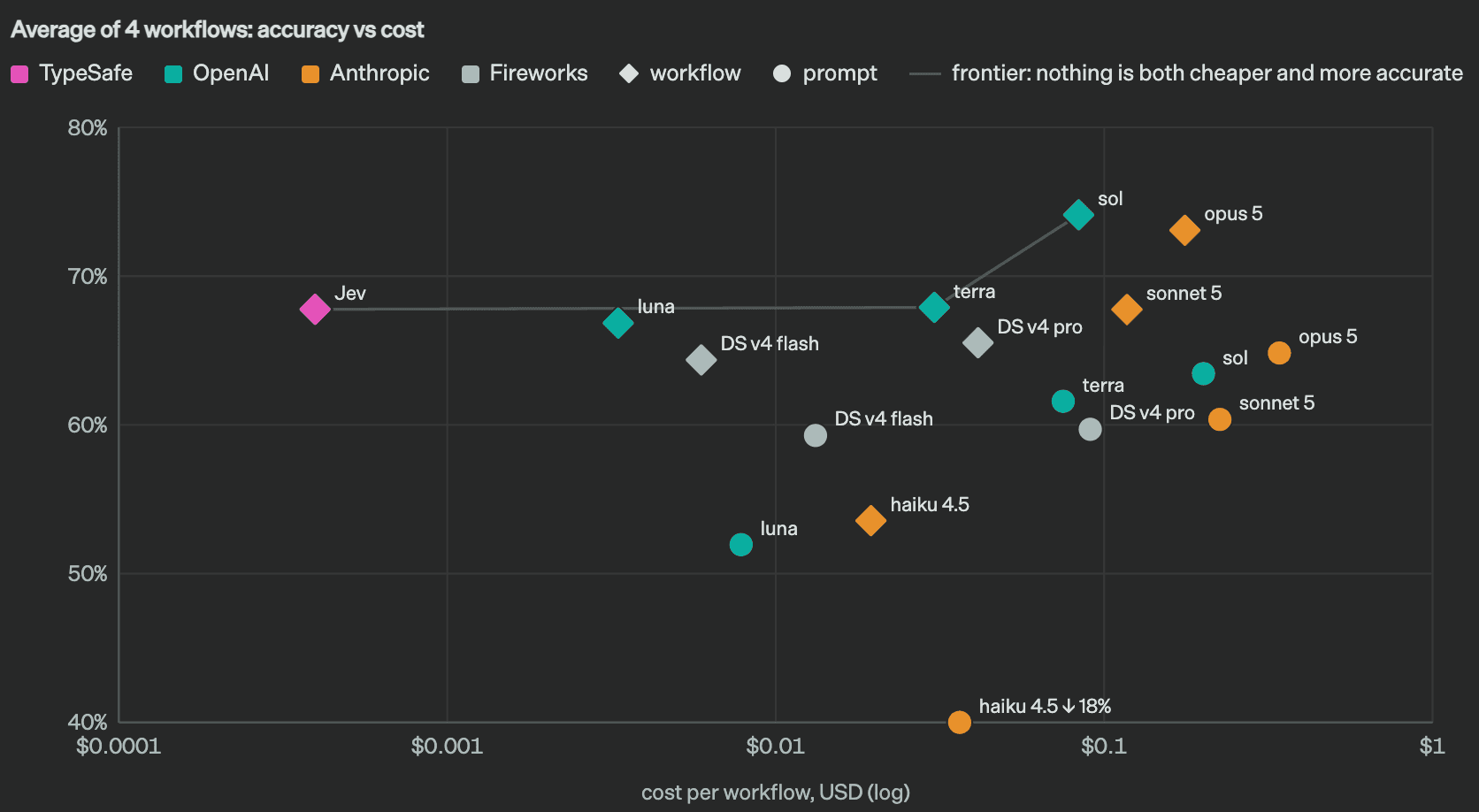
Jev is off the charts – owning the Pareto frontier for almost 2 orders of magnitude. We also compare to models with a generated prompt doing all the logic in their chain-of-thought, but this tends to do significantly worse than using the workflow itself.
Note that the calls here are significantly more complex than the side-by-side demonstration above. That’s because they’re more representative of the types of production workloads needed for true business automation. Below is the simplest of the 4 workflows we’re publishing:
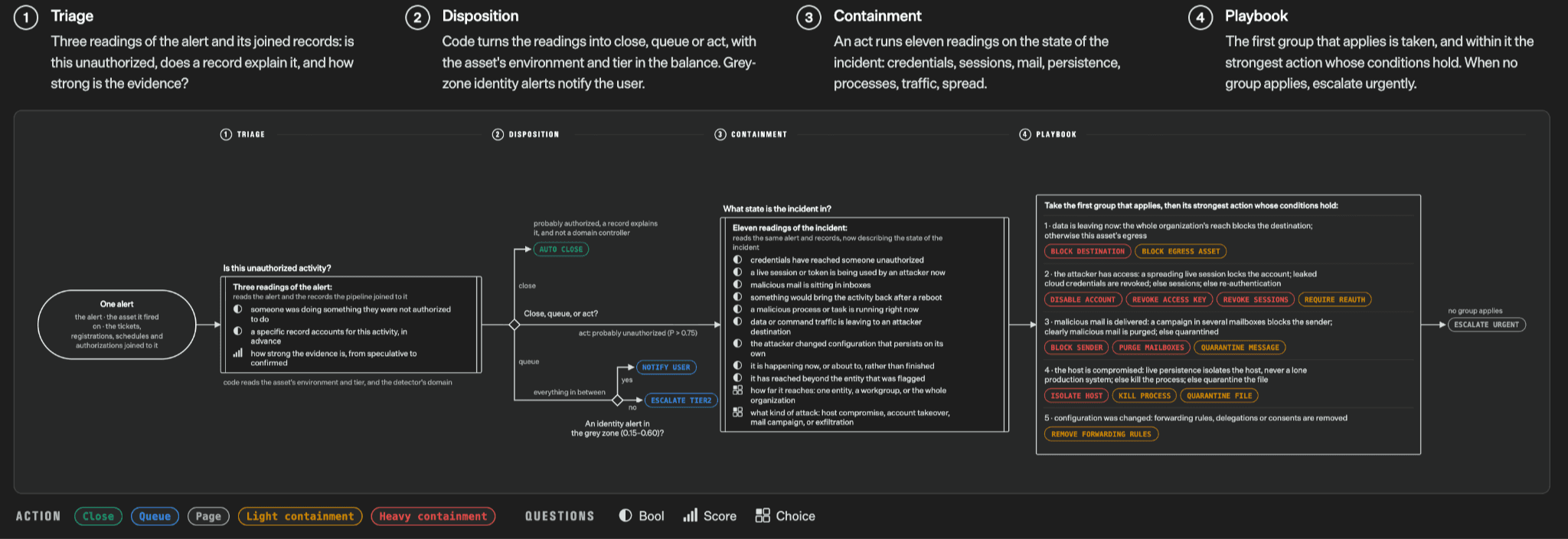
The most reliable real-world workflows tend to have many independent, decomposed questions, with fine-grained behavior that’s dependent on probabilities instead of discrete decisions. The end result is discrete branching, but how we get to a final answer involves a lot of domain-specific engineering that needs to be done highly consistently.
See our workflow evals site for all the details: examples, disagreements, full queries, and each workflow.
中文译文 05
311 字换句话说,每个模型都运行相同工作流。我们测试它们与最强模型平均结果之间的差异;这里的参考模型是 Astra 和 Fable。
Jev 的表现极为突出,在帕累托前沿上取得了接近两个数量级的优势。我们也比较了另一种方式:使用生成的提示,让模型在思维链中完成全部逻辑。但它的表现通常明显不如直接运行工作流。
请注意,这里的调用比前面的并排演示复杂得多,因为它们更能代表真正业务自动化所需的生产负载。下面展示的是我们公开的四个工作流中最简单的一个:
最可靠的实际工作流往往包含许多拆分后的独立问题,细致的行为依赖概率,而不是直接依赖离散决策。最终结果虽然是离散分支,但得出最终答案的过程涉及大量领域专项工程,而且必须非常一致地执行。
全部细节,包括示例、分歧、完整查询和各个工作流,都可以在我们的工作流评估网站查看。 [1]
上下游
本块首次出现的来源与延伸
本块相关内容已在前文介绍
判断
对本块内容的判断
“符合参考答案”“符合输出结构”“符合业务真值”是不同标准,不应在指标之间跳换。
核验与延伸:TypeSafe · Workflow evals ↗ · TypeSafe · Introducing System One Models & Jev ↗ · TypeSafe · System One Adapter ↗ · TypeSafe · Confidence ↗
解释
本块首次出现的知识点
本块相关内容已在前文介绍
英文原文 06
218 词 · 1 张图Nuance
This is where the claims of 193.6x faster, 444.6x cheaper on our home page comes from, and we expect that these are on the higher end of real world gains.
These content of these workflows were not deliberately chosen nor constructed to make our model look good, and are not in our training distribution. However, they were made by individuals on our model capabilities team, so some bias could exist.
We use the average of GPT-6 Astra and Fable 5.1 as the reference answer, which biases answers towards OpenAI and Anthropic’s models. We likely underestimate the relative performance of our model and DeepSeek’s models.
The LLMs use our System One LLM wrapper, which constrains LLMs to output structured decisions compatible with our API. We have found this to be the most accurate way to get decisions from LLMs, but this tends to be slower and more expensive than giving decisions without probabilities.
Hallucination and Type-safety
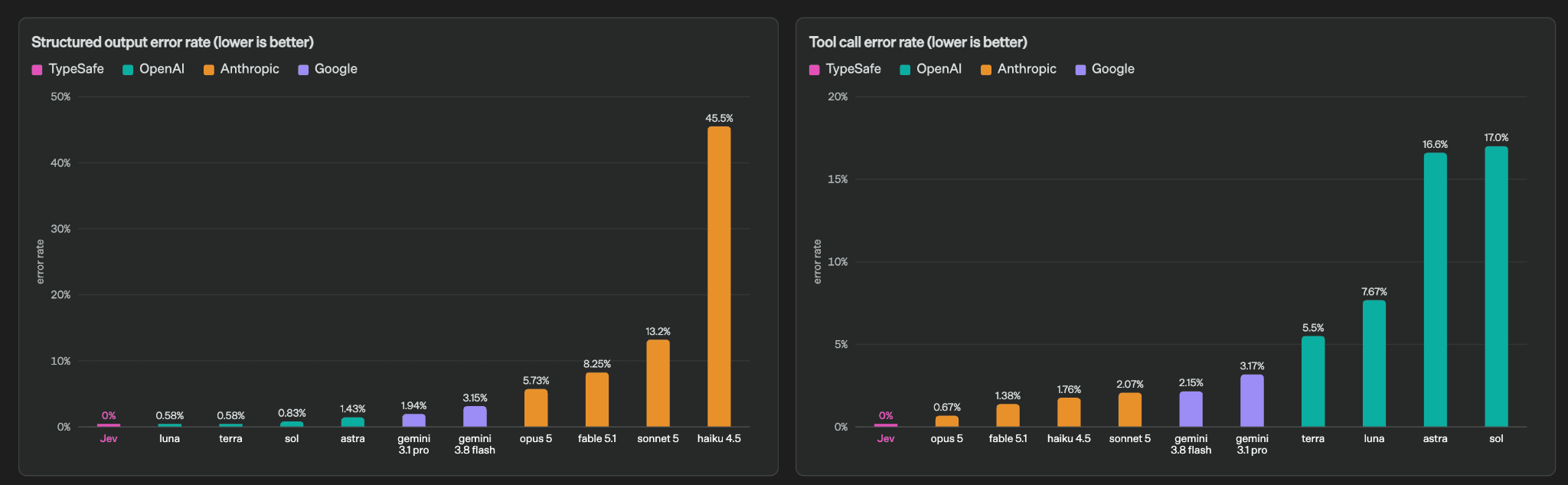
Hallucination and type-safety are intrinsically related, and we think the latter is table stakes for automation. Having a hallucinated tool call is inconvenient in an agent, but is an absolute deal-breaker if it’s part of a system with latency guarantees or it’s buried several layers deep in a dependency chain. Existing models, no matter how smart, still hallucinate and have type errors.
中文译文 06
363 字补充说明与限制
主页上“速度提升 193.6 倍、成本降低至约 1/444.6”的主张就来自这里。我们预计,这些数值处于实际应用收益较高的一端。
这些工作流的内容并未刻意挑选或设计成有利于我们的模型,也不属于我们的训练分布。但它们由模型能力团队的成员制作,所以仍可能存在一定偏差。
我们采用 GPT-6 Astra 与 Fable 5.1 的平均值作为参考答案,这会让答案偏向 OpenAI 和 Anthropic 的模型。我们很可能低估了我们自己的模型以及 DeepSeek 模型的相对表现。
参与比较的大语言模型使用我们的 System One LLM 封装器,把输出限制为与我们 API 兼容的结构化决策。我们发现,这是从大语言模型获取决策最准确的方式,但相较于不要求输出概率的决策,它通常更慢、更贵。 [1]
幻觉与类型安全
幻觉与类型安全存在内在联系,我们认为后者是自动化的基本门槛。智能体中出现幻觉式工具调用固然不便,但如果它属于有延迟保证的系统,或深藏在多层依赖链中,就会成为无法接受的缺陷。现有模型无论多聪明,仍然会产生幻觉与类型错误。
上下游
本块首次出现的来源与延伸
本块相关内容已在前文介绍
判断
对本块内容的判断
“符合参考答案”“符合输出结构”“符合业务真值”是不同标准,不应在指标之间跳换。
核验与延伸:TypeSafe · System One Adapter ↗ · TypeSafe · Introducing System One Models & Jev ↗ · TypeSafe · Workflow evals ↗ · TypeSafe · Confidence ↗
解释
本块首次出现的知识点
本块相关内容已在前文介绍
英文原文 07
189 词Nuance
The numbers for LLMs are from OpenRouter i.e., there almost certainly is bias here: more complex queries might be routed to better models.
Our number is not empirical. Schema matching is guaranteed, thus we can confidently add 0% into the plots.
Fun Demos
Perhaps the most exciting part of our work is enabling new use cases. We have a lot more to show you, but here are a couple of the team’s favorites:
Doom
We love how this doomo doomonstrates real-time intelligence and what can be doone with code + AI. The engineer behind it was worried about making 10 queries a second (which ends up costing ~$7/hour), but the rest of us agreed that was lower than expected! This is so fun we intend to not only release an in-depth walkthrough, but also host some events to hack on this.
Nuance
The demo is on structured state as a data structure with text, not on images (yet…)
A non-AI doom bot could play better, but we wanted a bot that was reactive to different representations of game state, and most importantly… following instructions was cool as heck!
中文译文 07
353 字补充说明与限制
大语言模型的数据来自 OpenRouter,因此这里几乎肯定存在偏差:较复杂的查询可能被路由给更强的模型。
我们的数值不是实验测量结果。输出与预定义结构的匹配有保证,因此我们可以有把握地在图中标出 0%。
趣味演示
这项工作最令人兴奋的部分,或许是它能带来新的应用场景。我们还有很多东西想展示,这里先介绍团队最喜欢的两个例子:
Doom
我们很喜欢这个 Doom 演示展现出的实时智能,以及代码与 AI 结合所能做到的事情。负责它的工程师曾担心每秒发起 10 次查询的费用,算下来大约每小时 7 美元,但其他人都觉得比预期低!这实在太有趣了,我们不仅打算发布详细教程,还想举办一些活动,一起动手探索。
补充说明与限制
这个演示使用的是包含文本的数据结构所表示的结构化状态,目前还不是图像输入。
不使用 AI 的 Doom 机器人可能玩得更好,但我们想要一个能对不同游戏状态表示作出反应的机器人。更重要的是,能够遵循指令实在太酷了!
上下游
本块首次出现的来源与延伸
保留原站入口;未运行演示。
只归档播放器保留原站入口;未运行演示。
只归档播放器本块新增 2 项 · 另有 4 项已在前文介绍
判断
对本块内容的判断
“符合参考答案”“符合输出结构”“符合业务真值”是不同标准,不应在指标之间跳换。 视频保留原站入口;原文的产品路线与FAQ按所供文件的实际范围呈现。
演示输入与推理档位影响结论
Doom输入是结构化文本状态,不是直接读取游戏图像;维基竞速中的LLM多采用非推理模式。两者都不能直接代表相同预算下的一般模型优劣。视频播放器已保存,但没有宣称观看或复现完整视频。
核验与延伸:TypeSafe · Introducing System One Models & Jev ↗ · TypeSafe · Workflow evals ↗ · TypeSafe · System One Adapter ↗ · TypeSafe · Confidence ↗
解释
本块首次出现的知识点
本块相关内容已在前文介绍
英文原文 08
191 词Wikiracing
The objective of the game is to start on one Wikipedia page and reach a specific other Wikipedia page using only links you come across while traversing. Each step can mean choosing between hundreds to thousands of links! It’s a great playground for demonstrating not just intelligence-per-second, but also the compounding benefits of not hallucinating with high-cardinality choices.
Nuance
As far as we know, it was completely random that both the 2nd and 3rd challenges started with “Rubber Duck.” The author only noticed when the team pointed it out.
Our speedups here tend to be a lot less than in previous demos. That’s because this is against the non-reasoning modes of the models (except Astra which was set to the lowest reasoning setting). This is also why Jev tended to finish in fewer steps (a sign of greater intelligence). This was to make the demo more bearable to watch. The LLMs look much worse at this task than with reasoning enabled.
Jev supports a cardinality up to 255. For the higher cardinality choices, we do a 2 stage-system of scoring independently then making an explicit choice, hence the occassional slowdown.
中文译文 08
315 字维基竞速
游戏目标是从一个维基百科页面出发,只使用沿途页面出现的链接,到达另一个指定页面。每一步可能都要从数百乃至数千个链接中选择!它既能展示单位时间内的智能表现,也能展示在候选数量很大时、不凭空编造选项所带来的累积优势。
补充说明与限制
据我们所知,第二项和第三项挑战都从“Rubber Duck(橡皮鸭)”开始,完全是巧合;直到团队成员指出,作者才注意到这一点。
这里的提速通常远小于前面的演示,因为比较对象采用非推理模式,只有 Astra 被设为最低推理档位。这也解释了为什么 Jev 往往用更少步骤完成任务,这是一种智能更强的迹象。这样设置是为了让演示看起来不那么漫长;与开启推理相比,大语言模型在这项任务中的表现差了很多。
Jev 支持最多 255 个候选选项。候选数量更多时,我们采用两阶段系统:先分别评分,再作出明确选择,因此偶尔会变慢。
上下游
本块首次出现的来源与延伸
本块相关内容已在前文介绍
判断
对本块内容的判断
视频保留原站入口;原文的产品路线与FAQ按所供文件的实际范围呈现。
核验与延伸:TypeSafe · Introducing System One Models & Jev ↗ · Doom演示视频 ↗ · Wikiracing演示视频 ↗
解释
本块首次出现的知识点
本块相关内容已在前文介绍
英文原文 09
259 词What’s next
We’re still in Jev’s early days. We have a lot more in the pipeline and are so excited to keep on shipping 🔥.
Today, we are opening early access and bringing developers off the waitlist as quickly as we can. We want to hear which decisions you need to automate, where Jev works, and where it falls short. Tell us what sci-fi you want to build!!
We started TypeSafe because we believe that AI needs an interface software could depend on. We can't wait to see new use cases continuously diffuse through the community and economy.
We Give A FAQ
Where do the names “System One Models” and “Jev” come from?
We were inspired by Daniel Kahneman, Thinking, Fast and Slow. The model class name draws on the distinction between fast, intuitive System 1 thinking and slow, deliberate System 2 reasoning.
“System 1 thinking” has also implied error-prone. For reasons we will get into in the future, we believe System One Models can be made more reliable than its alternatives.
We named Jev after William Stanley Jevons. We expect machine intelligence to follow a similar path to coal, after steam-engine efficiency led to an increase in demand. Every order of magnitude drop in the cost of intelligence unlocks orders of magnitude more use cases.
Why was a new training algorithm needed?
What use cases is Jev good for?
Is Jev just a smaller LLM?
How does Jev perform against public benchmarks?
Where does our training data come from?
These are results are kinda crazy - how is it possible?
中文译文 09
444 字下一步
Jev 仍处于早期阶段。我们还有许多后续工作,十分期待持续推出新成果。🔥
今天,我们开放抢先体验,并尽快让候补名单中的开发者获得使用资格。我们想了解,你们需要自动化哪些决策,Jev 在哪里有效、又在哪里不足。告诉我们,你们想把怎样的科幻构想变成现实! [1]
我们创立 TypeSafe,是因为我们相信 AI 需要一个软件能够依赖的接口。我们迫不及待地想看到新的应用场景持续扩散到社区与经济活动中。
常见问题
“System One Models”和“Jev”这两个名字从何而来?
我们的灵感来自丹尼尔·卡尼曼的《思考,快与慢》。模型类别的名称,借鉴了快速、直觉式的系统 1 思考,与缓慢、审慎的系统 2 推理之间的区别。 [1]
“系统 1 思考”也常暗含容易犯错的意思。不过,基于我们今后会进一步讨论的理由,我们相信 System One 模型可以比其他选择更加可靠。
我们以威廉·斯坦利·杰文斯(William Stanley Jevons)的名字为 Jev 命名。蒸汽机效率提高曾使煤炭需求上升,我们预计机器智能也会走上类似道路:智能成本每下降一个数量级,就会解锁多出若干数量级的应用场景。
为什么需要一种新的训练算法?
Jev 适合哪些应用场景?
Jev 只是一个更小的大语言模型吗?
Jev 在公开基准上的表现如何?
我们的训练数据来自哪里?
这些结果有些惊人,究竟是怎么做到的?
上下游
本块首次出现的来源与延伸
来源身份与原文对应;未把链接存在当作事实核验。
保留来源;未独立逐项核验来源身份与原文对应;未把链接存在当作事实核验。
保留来源;未独立逐项核验本块新增 2 项 · 另有 3 项已在前文介绍
判断
对本块内容的判断
视频保留原站入口;原文的产品路线与FAQ按所供文件的实际范围呈现。
FAQ后续问题没有保存展开答案
提供文件只包含第一个FAQ的展开答案,后六项只有问题。页面保留问题并给出原站入口,不凭模型知识补写作者答案。
核验与延伸:early access ↗ · Thinking, Fast and Slow ↗ · TypeSafe · Introducing System One Models & Jev ↗ · Doom演示视频 ↗
解释
本块首次出现的知识点
本块相关内容已在前文介绍
来源与阅读说明
用户提供的是浏览器翻译后的中文网页,已逐项对齐对应官网英文正文的105个单元,修正“字符串”“大语言模型”等明显机器误译;原始中文保存件仍在文章档案中。
保留4张所供PNG、完整比较表格与正文。图片可以在共享查看器放大,表格在窄栏内横向滚动。未运行API或性能测试。
3个演示仅保存了播放器页面,没有视频文件;可从“上下游”打开原站视频。FAQ后6项仅有问题,未保存展开答案;请到原文查看。