

Jev’s Architecture Unmasked
Jev 架构揭秘
5,826 个英文词 · 25 个原文块 · 8 张保存图片 · 完整英中对照 · 黑箱研究,非官方架构披露

总结
Archer Hume用API探测、公开文档与先前研究重建Jev的可能架构。本文保留完整中英对照,并明确区分官方说明、实验观察与尚未证实的推断。
核心阅读线索是直接概率读出、共享状态与隔离问题,以及概率校准和confidence字段的区别;五张图表与三条公式保持原站静态呈现。
- Jev
- 黑箱实验
- 共享前缀
- 概率校准
- MoE
英文原文 01
247 词X is full of hot takes about Jev’s launch, and most miss the point entirely: “12 million views for a JSON classifier? Yeah, we’re in a bubble.” An ordinary LLM generates “90% confident” as text; its probability of producing those words does not establish a 90% probability of being right. Yet we build fraud screening, moderation, routing and risk assessment around precisely this pattern: paying for token-by-token generation, then treating an unvalidated confidence claim as a probability our software can act on.
Jev’s proposition is to retain the knowledge of a pretrained LLM while replacing generated confidence claims with decision probabilities read directly from its internal representations. Those probabilities are trained against outcomes. Give it shared state, questions, and allowed answers; it returns the distributions in parallel, without generating text.1 For this whole class of applications, that addresses both problems: the reliability of the decision signal and the unnecessary computation spent producing it.
Theres just one problem, its not open weight, and TypeSafe refuses to share their research… So I will (try my best).
The evidence points toward a causal transformer (likely using sparse MoE) repurposed for decisions: shared-state encoding, isolated question branches, and direct probability readouts instead of text generation. After probing the TypeSafe API (looking for signatures in latency scaling under different context lengths, question reordering, etc.), scouring any public documentation and research with Astra, and looking for prior art, I think I have a fairly accurate model of how it works and its architecture.
中文译文 01
478 字X 上到处都是关于 Jev 发布的热点评论,而大多数完全没有抓住重点:“一个 JSON 分类器竟然有 1200 万浏览量?没错,我们正处于泡沫之中。”普通大语言模型会把“有 90% 的把握”生成为文字,但生成这些文字的概率,并不能证明答案有 90% 的概率正确。然而,我们构建欺诈筛查、内容审核、路由和风险评估时,恰恰在沿用这种模式:花钱让模型逐 token 生成,再把未经验证的置信度表述,当成软件可以据以行动的概率。 [1]
Jev 提出的思路,是保留预训练大语言模型的知识,同时把生成式的置信度声明,换成直接从内部表示读出的决策概率。这些概率根据实际结果进行训练。给它共享状态、问题和允许的答案,它就会并行返回分布,而不生成文本。对于这一整类应用,这同时解决了两个问题:决策信号的可靠性,以及为了输出这个信号而付出的不必要计算。 [1] [2]
但有一个问题:它没有开放权重,TypeSafe 也不愿公开研究……那就由我来试着还原吧,至少尽我所能。
现有证据指向一种为决策任务改造的因果 Transformer,很可能采用稀疏 MoE:共享状态编码、彼此隔离的问题分支,以及直接输出概率的读出机制,替代文本生成。我对 TypeSafe API 做了探测,例如观察不同上下文长度、问题重排等条件下的延迟变化;又借助 Astra 搜寻公开文档、研究与先前方法。综合这些信息,我认为自己已经建立了一个相当接近实际的工作机制与架构模型。
上下游
本块首次出现的来源与延伸
来源身份与原文对应;未把链接存在当作事实核验。
保留来源;未独立逐项核验提供并行结构化输出与RLCD的公开定位;不公开本文推测的完整底层架构。
已在ReadLess收录并核对作者对jev-1.13.0的黑箱研究;本文译出其完整论证,不将架构重建冒充官方披露。
原文链接;未将未核验内容当作新证据本块新增 3 项
判断
对本块内容的判断
作者提出的是一个解释框架;静态架构图中的颜色、路径和概率都是示意。
标题中的“揭秘”不等于内部架构已经确认
作者主动区分公开说明、API观察和解释。其中共享上下文与并行结构化输出更有支持;因果骨干、读出头具体形式和稀疏专家仍不唯一。全文保留“我预计”“可能”等语气。
核验与延伸:“12 million views for a JSON classifier? Yeah, we’re in a bubble.” ↗ · TypeSafe · Introducing System One Models & Jev ↗ · Archer Hume · Jev’s Architecture Unmasked ↗
解释
本块首次出现的知识点
本文解释:从观察到架构,中间有多远
同样的输入输出行为,可能由不同内部结构实现。黑箱实验可以让某些假设更不可信,却往往不能只凭一个现象锁定唯一结构。阅读时把“与某方案一致”和“证明采用某方案”分开。
本文解释:预填充与自回归解码
预填充处理的是已经给定的整段输入,因此一层中的多个位置可以并行计算,再由掩码限制可见信息。自回归解码还要等待上一个输出被选定,才能生成下一个。本文推测的系统在读出概率后就结束,避免了这条输出依赖链。
本块新增 2 项
英文原文 02
252 词 · 1 张图The sparse backbone is the least certain part, but its particularly beneficial for this domain with less downsides than AR LLMs, so would be weird if it wasn’t . Shared computation and direct probability outputs are much better supported obviously. This is clearly all quite speculative, so I’ll try and be as clear as possible around what evidence was published by TypeSafe, what was observed in experiments, and whats inferred from them. Black box APIs make it shockingly easy to throw a blanket over the ghost and get a rough shape of what the architecture looks like.
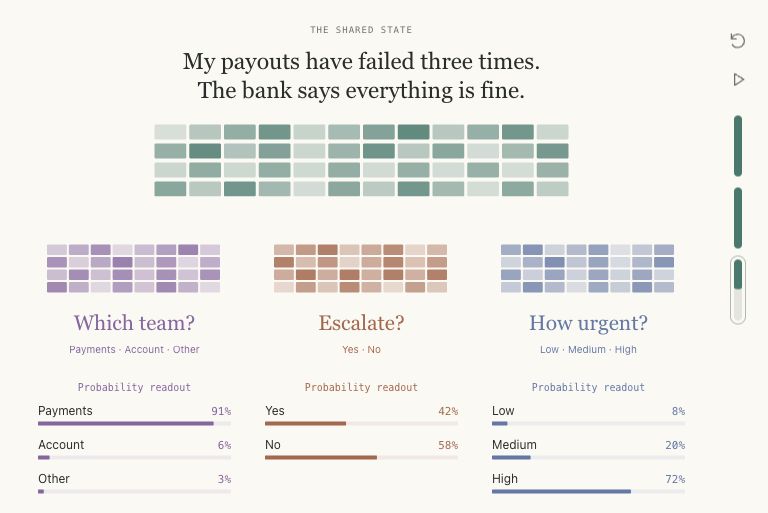
Why this design is useful
Consider a schematic support-routing request. This illustrates the API’s structure; the example probabilities below are invented.
{
  "state": "My payouts have failed three times. The bank says everything is fine. Can someone please fix this?",
  "questions": {
    "queue": {
      "type": "choice",
      "instructions": "Which team should handle this ticket?",
      "criteria": {
        "payments": "Payout failures and payment processing",
        "account": "Login and account access",
        "other": "Something else"
      }
    },
    "escalate": {
      "type": "noul",
      "instructions": "Does this message require urgent human attention?"
    }
  }
}
中文译文 02
424 字稀疏骨干是其中最不确定的部分,但它对这类任务尤其有利,又比用于自回归大语言模型时少一些代价,所以如果实际没有采用,反而会让我感到意外。共享计算和直接概率输出显然有更充分的支持。总之,这些仍有很大推测成分,因此我会尽量清楚地区分:TypeSafe 公开了什么,实验观察到了什么,以及从中推断出了什么。黑箱 API 让人惊讶地容易做到一件事:仿佛给幽灵披上一条毯子,勾勒出架构的大致轮廓。
为什么这种设计有用
考虑下面这个客服工单路由请求示例。它用于说明 API 的结构,下面给出的示例概率是虚构的。
{
  "state": "My payouts have failed three times. The bank says everything is fine. Can someone please fix this?",
  "questions": {
    "queue": {
      "type": "choice",
      "instructions": "Which team should handle this ticket?",
      "criteria": {
        "payments": "Payout failures and payment processing",
        "account": "Login and account access",
        "other": "Something else"
      }
    },
    "escalate": {
      "type": "noul",
      "instructions": "Does this message require urgent human attention?"
    }
  }
}上下游
本块首次出现的来源与延伸
本块相关内容已在前文介绍
判断
对本块内容的判断
作者提出的是一个解释框架;静态架构图中的颜色、路径和概率都是示意。
核验与延伸:Archer Hume · Jev’s Architecture Unmasked ↗ · TypeSafe · Introducing System One Models & Jev ↗
解释
本块首次出现的知识点
本块相关内容已在前文介绍
英文原文 03
244 词A useful answer might assign payments 0.91 probability while assigning urgent escalation only 0.42. Those are different uncertainties. Software can route the ticket automatically while leaving escalation to a separate policy.
A causal transformer already knows how to construct a representation of text from left to right. During ordinary language-model inference, it processes the prompt, predicts one token, feeds that token back in, and repeats. This builds on the decoder attention and output projection introduced in the original Transformer.3 But the prompt-processing stage has already produced a rich representation. If the task is to choose among three queues, we can attach a small function that maps that representation directly to three numbers.
A detail here resolves much of the confusion about parallel answers: causal attention describes which positions can use which information, not the order in which input tokens must be executed. During prompt processing, or prefill, every input token is already known. The model can process their positions together within a layer while the attention mask blocks access to later positions; the layers still run sequentially. Autoregressive decoding adds another dependency: the next token does not exist until the previous prediction has been chosen. Our proposed model ends after prefill and the readout, so it avoids that token-by-token dependency.
This changes the computational shape of the task. The output no longer needs a sequence of spelling decisions for "payments": 0.91. JSON formatting happens in ordinary application code. The neural network supplies the probabilities.
中文译文 03
450 字一个有用的回答,可能给 payments 分配 0.91 的概率,却只给“紧急升级处理”分配 0.42。这是两种不同的不确定性。软件可以自动把工单路由到对应队列,同时用另一套独立规则决定是否升级处理。
因果 Transformer 已经知道如何从左到右构建文本表示。在普通语言模型推断中,它处理提示、预测一个 token、把该 token 送回输入,再不断重复。这建立在原始 Transformer 提出的解码器注意力和输出投影之上。但处理提示的阶段已经产生了丰富的表示。如果任务只是从三个队列中选择一个,我们可以接上一个小函数,直接把这种表示映射为三个数。 [1]
这里有一个细节,可以澄清关于并行回答的许多困惑:因果注意力规定的是各个位置可以使用哪些信息,而不是输入 token 必须按什么时间顺序执行。在提示处理,也就是预填充(prefill)阶段,所有输入 token 都已经已知。模型可以在一层中同时处理这些位置,由注意力掩码阻止它们访问后面的位置;层与层之间仍然顺序执行。自回归解码则增加了另一条依赖:只有前一个预测结果被选定后,下一个 token 才存在。我们提出的模型在预填充与读出之后就结束,因此避开了这种逐 token 依赖。
这改变了任务的计算形式。输出不再需要经过一连串字符选择,去拼出 "payments": 0.91。JSON 格式由普通应用代码处理,神经网络只提供概率。
上下游
本块首次出现的来源与延伸
本块相关内容已在前文介绍
判断
对本块内容的判断
作者提出的是一个解释框架;静态架构图中的颜色、路径和概率都是示意。
核验与延伸:Archer Hume · Jev’s Architecture Unmasked ↗ · TypeSafe · Introducing System One Models & Jev ↗
解释
本块首次出现的知识点
本块相关内容已在前文介绍
英文原文 04
256 词Now suppose the state is a lengthy incident report, and there are fifty questions. Most of the input is shared. A transformer stores intermediate information about processed tokens in its key–value cache, usually shortened to KV cache. In the proposed design, every question reads the same state cache. Each branch adds only its own instructions and answer options.
For a state of S tokens and Q questions, separate requests would process the state roughly Q times. Sharing reduces the repeated state-token processing from QS to S. The questions still have to attend to the state; that work does not disappear. But the model need not repeatedly reconstruct the state’s representations.
Isolation also gives the interface a useful meaning. Asking whether the customer is angry should not change which queue receives the ticket. Both questions can inspect the same evidence without reading each other’s instructions. The branches have no computational dependency on one another, even when their answers are statistically related.
Finally, probabilities make downstream policy explicit. If an unnecessary escalation costs one unit and a missed urgent case costs nine, a simplified decision rule escalates when p(\text{urgent}) > 0.1. That calculation is meaningful only to the extent the probabilities are reliable for this workflow. Training and evaluating the probability distribution therefore becomes part of the product, rather than a cosmetic confidence field.
None of this requires diffusion. Parallel classification has existed for decades. The interesting combination is a broadly capable transformer, shared contextual computation, a typed output interface, and training that rewards useful uncertainty.
中文译文 04
457 字现在假设状态是一份很长的事件报告,要回答五十个问题。大部分输入是共享的。Transformer 会把已处理 token 的中间信息保存在键值缓存中,通常简称 KV cache。在这里提出的设计中,每个问题都读取同一份状态缓存,各分支只添加自己的指令和答案选项。
如果共享状态有 S 个 token,要回答 Q 个问题,分别发送请求就会大致重复处理状态 Q 次。共享计算把重复的状态 token 处理量从 QS 降到 S。问题仍然需要关注共享状态,这部分工作并没有消失;但模型不必反复重建状态表示。
隔离也赋予接口清晰的含义:询问客户是否生气,不应改变工单被分配到哪个队列。两个问题都能检查同一份证据,但不读取对方的指令。即使答案在统计上相关,两个分支也没有计算依赖。
最后,概率使下游规则更加明确。如果一次不必要的升级处理造成 1 单位成本,而漏掉一个紧急事件造成 9 单位成本,那么一个简化的规则是:当 p(urgent) > 0.1 时升级处理。这个计算是否有意义,取决于概率对当前工作流是否可靠。因此,训练和评估概率分布成为产品的一部分,而不只是提供一个装饰性的置信度字段。
这些都不需要扩散模型。并行分类已经存在几十年。真正有意思的组合是:能力广泛的 Transformer、共享上下文计算、带类型的输出接口,以及奖励有用不确定性的训练方法。
上下游
本块首次出现的来源与延伸
本块相关内容已在前文介绍
判断
对本块内容的判断
作者提出的是一个解释框架;静态架构图中的颜色、路径和概率都是示意。
核验与延伸:Archer Hume · Jev’s Architecture Unmasked ↗ · TypeSafe · Introducing System One Models & Jev ↗
解释
本块首次出现的知识点
本块相关内容已在前文介绍
英文原文 05
246 词1. End inference with a readout
The first component is the simplest: a prediction head instead of a decode loop.
Published evidence. TypeSafe’s launch announcement says: “Jev outputs all probabilities in parallel instead of autoregressively generating by token.” Its documentation exposes finite choices, yes/no decisions, and ordered scores. These are naturally represented by fixed numerical outputs.12
Observed evidence. The API still reports an output_tokens field, which sounds like a record of generation. It isn’t one. For yes/no questions, the count fits exactly: 4 shared tokens, plus 15 per answer, plus the token length of each question’s identifier. TypeSafe’s documentation says that identifier “is not sent to the underlying model and is not used in inference.” A count that changes with text the model never sees is calculated after inference, from the serialised response. The returned values don’t affect it either: an answer of 0.0 costs the same as 0.01, although each digit otherwise counts as a token.224
The tokenizer behind the count doesn’t match any of the 192 public tokenizers we tested. It does match Jev’s own input counter for ordinary text, differing only on long runs of whitespace and punctuation. output_tokens is a billing figure. It tells us nothing about whether Jev generates text, and wouldn’t measure that text even if it did. Latency doesn’t track that figure either: a question with 200 options (1,911 output tokens) returned as quickly as one with two, and server time grew only with input length.2425
中文译文 05
424 字1. 用读出模块结束推断
第一个组成部分最简单:用预测头替代解码循环。
公开证据。TypeSafe 的发布公告表示:“Jev 并行输出所有概率,而不是逐 token 自回归生成。”其文档提供有限选项选择、是非决策和有序评分。这些输出天然适合用固定的数值表示。 [1] [2] [3] [4]
实验观察。API 仍然返回一个 output_tokens 字段,听起来像是生成记录,但它并不是。对于是非问题,计数恰好符合以下公式:4 个共享 token,加上每个答案 15 个 token,再加上每个问题标识符的 token 长度。TypeSafe 文档说,这个标识符“不会传给底层模型,也不用于推断”。如果计数会随模型根本看不到的文本而变化,那么它就是在推断结束后,根据序列化响应计算的。返回的数值本身也不影响计数:0.0 和 0.01 的计费相同,尽管在其他情况下每个数字各算一个 token。 [1] [2] [3]
这一计数背后的分词器,与我们测试的 192 个公开分词器都不匹配。对于普通文本,它倒是与 Jev 自己的输入计数器一致,只在长串空白和标点上不同。output_tokens 是一个计费数字,不能说明 Jev 是否生成文本;即使 Jev 真的生成文本,它也不是对那段文本的实际测量。延迟也不随这个数字变化:200 个选项、返回 1,911 个输出 token 的问题,与只有两个选项的问题同样快;服务端耗时只随输入长度增加。 [1] [2]
上下游
本块首次出现的来源与延伸
来源身份与原文对应;未把链接存在当作事实核验。
保留来源;未独立逐项核验问题ID不传给底层模型的说明支持区分服务端计数与模型生成步骤。
已读问题标识符、问题类型与响应定义作为共享前缀方案的参考,不作为Jev采用该库的证据。
论文来源已定位;本文未复现本块新增 3 项 · 另有 2 项已在前文介绍
判断
对本块内容的判断
作者提出的是一个解释框架;静态架构图中的颜色、路径和概率都是示意。 把公开接口、服务端计数和内部计算区分开;不存在仅凭字段名称就能恢复架构的捷径。
计费字段不能直接换算神经解码吞吐
官方API文档确认问题ID不传入底层模型。作者观察到output_tokens随ID变化,这支持它包含服务端记账逻辑;仅用该字段除以耗时无法确定逐token生成速度。我们未重跑其tokenizer探测。
核验与延伸:TypeSafe · Introducing System One Models & Jev ↗ · TypeSafe. Full API documentation, accessed 17 September 2026. Typed questions, response distributions, and API contract. ↗ · Archer Hume · Jev’s Architecture Unmasked ↗ · TypeSafe · API reference ↗
解释
本块首次出现的知识点
本文解释:计算隔离不等于统计独立
工单是否紧急、属于哪个队列,可能因为同一段状态而相关。问题分支互不读取彼此的指令,只说明计算路径上的隔离;不能据此说两个答案在统计上独立。
本块新增 1 项 · 另有 2 项已在前文介绍
英文原文 06
247 词 · 1 张图A 255-option response reported 2,714 output tokens.4 It would be a mistake to divide that number by request duration and call the result the model’s decoding speed. A server can serialize thousands of characters after a single model evaluation. The accounting field does not tell us how many neural decoding steps occurred.
The proposed readout takes a final hidden vector h and produces logits:

Here K is the number of allowed answers. The matrix W converts a representation into answer scores; softmax turns those scores into a distribution. For a yes/no decision, one scalar and a sigmoid would suffice.
The classes need not be fixed concepts such as “payments”. They can be option slots: first option, second option, third option. The branch supplies each slot’s meaning; application code maps its probability back to the caller’s option key. An ordered Score can similarly predict probabilities over levels and return their probability-weighted average. This supports new decisions without training a new head for each customer’s labels. A pointer-style scorer, compared in section 4, is the main alternative: it scores each option’s own representation instead of a numbered slot.
This does not establish that Jev has a separately named classifier module. A language model’s vocabulary head is also a matrix followed by softmax. Selecting K reserved label rows from that matrix can implement the same computation as a dedicated K-class head. The rows might be tied to input embeddings or trained independently; we cannot distinguish those arrangements here.
中文译文 06
430 字一个含 255 个选项的响应,报告了 2,714 个输出 token。把这个数字除以请求时间,再称之为模型的解码速度,是错误的。服务端可以在一次模型计算之后序列化数千个字符;这个计数字段并不能告诉我们发生了多少次神经网络解码步骤。 [1]
所提出的读出模块取最终隐藏向量 h,计算 logits:
这里,K 是允许的答案数量。矩阵 W 把表示转为答案分数,softmax 再把分数变成概率分布。对于是非决策,一个标量加上 sigmoid 就足够了。
这些类别不必是“payments”这样的固定概念,也可以是选项槽位:第一个、第二个、第三个选项。分支提供各槽位的含义,应用代码再把概率映射回调用者的选项键。有序 Score 同样可以预测各等级的概率,并返回按概率加权的平均值。这样就能支持新决策,而不必为每位客户的标签重新训练一个预测头。第 4 节将比较的指针式评分器,是主要替代方案:它对每个选项自身的表示打分,而不是对编号槽位打分。
这并不能证明 Jev 内部有一个单独命名的分类器模块。语言模型的词表头同样可以是一层矩阵映射加 softmax。从中选择 K 个预留标签对应的行,就能实现与专用 K 类预测头相同的计算。这些行可能与输入嵌入共享权重,也可能独立训练;这里无法区分这些安排。
上下游
本块首次出现的来源与延伸
本块相关内容已在前文介绍
判断
对本块内容的判断
把公开接口、服务端计数和内部计算区分开;不存在仅凭字段名称就能恢复架构的捷径。
核验与延伸:Archer Hume · Jev’s Architecture Unmasked ↗ · TypeSafe · API reference ↗ · Hydragen · 共享前缀推断 ↗
解释
本块首次出现的知识点
本块相关内容已在前文介绍
英文原文 07
287 词The important distinction is between reading out probabilities and generating text that describes probabilities. A generated “91%” is a token sequence. A classifier’s 0.91 is an entry in its predictive distribution. Either can be miscalibrated. Neither becomes trustworthy solely because of its format.
Constrained text decoding remains a possible way to build a similar interface, but TypeSafe explicitly describes a different output path. Its statement is stronger evidence than a latency argument. The evidence points to a direct numerical readout, one of the two designs compared in section 4. Reserved label tokens remain possible, although the fake-option test there weighs against them.
2. Share the state, isolate the questions
The next decision concerns where computation is reused.
Observed evidence. Token accounting is exactly additive in the small controlled examples. One minimal yes/no question used 268 input tokens; two used 276. A request containing one yes/no question, one two-option Choice, and one two-level Score used 318, matching the sum of their measured contributions above the shared overhead. This fits a common prefix plus question suffixes, though accounting alone does not identify a computational graph.4
A more informative experiment moves evidence between those regions. The state initially said:
The weather is nice today and the park is full of people.A sibling question contained:
The secret code for this request is ZEBRA-7741.
Is the weather described as nice?
The probe asked which code another question mentioned, with ZEBRA-7741, two distractors, and none as choices. With the secret in the sibling question, its reported probability was 0.00. Removing that sibling produced the same result. Putting the declaration in the state instead raised it to 0.90–0.92. These were five repeats per condition (visibility in the probe records).5
中文译文 07
494 字关键区别在于:直接读出概率,与生成描述概率的文本,是两回事。生成的“91%”是一段 token 序列;分类器的 0.91 则是预测分布中的一个值。两者都可能校准不良,也都不会仅仅因为格式不同就变得可信。
受约束的文本解码,也可能用来构建类似接口,但 TypeSafe 明确描述了另一种输出路径。厂商的这项声明,比单靠延迟作出的论证更有力。证据指向直接数值读出,也就是第 4 节比较的两种设计之一。预留标签 token 仍有可能,不过那里的假选项测试为这种解释提供了反向证据。
2. 共享状态,隔离问题
接下来的设计选择,是在哪里复用计算。
实验观察。在小规模受控示例中,token 计数严格可加:一个最小是非问题用了 268 个输入 token,两个用了 276。一个请求同时包含一个是非问题、一个二选项 Choice 和一个两级 Score 时,用了 318 个 token,恰好等于共享开销加上它们各自测得的增量。这符合“公共前缀加问题后缀”的解释,但仅凭计数并不能确定计算图。 [1]
一个更有信息量的实验,是把证据在这些区域之间移动。状态最初写着:
The weather is nice today and the park is full of people.一个同级问题包含:
The secret code for this request is ZEBRA-7741.
Is the weather described as nice?探测问题要求指出另一个问题中提到的暗号,选项包括 ZEBRA-7741、两个干扰项和 none。暗号放在同级问题中时,模型报告其概率为 0.00;移除那个同级问题,结果相同。把暗号声明改放到共享状态中,概率则上升到 0.90–0.92。每种条件重复五次,对应探测记录中的 visibility。 [1]
上下游
本块首次出现的来源与延伸
本块相关内容已在前文介绍
判断
对本块内容的判断
把公开接口、服务端计数和内部计算区分开;不存在仅凭字段名称就能恢复架构的捷径。
核验与延伸:Archer Hume · Jev’s Architecture Unmasked ↗ · TypeSafe · API reference ↗ · Hydragen · 共享前缀推断 ↗
解释
本块首次出现的知识点
本块相关内容已在前文介绍
英文原文 08
229 词 · 1 张图This is a useful intervention: moving the declaration across an API boundary changes its effect. It supports behavioural isolation between questions and access to the shared state. It does not expose the exact attention mask. Separate model calls, a tree mask, or another mechanism that restricts information flow could produce the same result. The probe’s wording also asks about “another question” even in the state condition, so it is not a pristine test of literal instruction following.
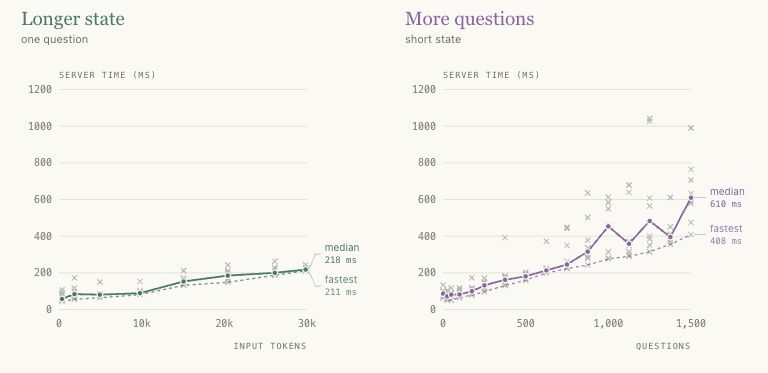
The serving measurements add another piece. Up to about 100 questions, server time barely changed. Beyond that it rose steadily, and token for token, question text cost roughly twice as much as state. That is consistent with computing the state once and batching the question work.6
中文译文 08
400 字这是一项有用的干预:把声明移过 API 的区域边界,会改变它的作用。它支持问题之间在行为上隔离、同时能够访问共享状态的结论,但没有暴露确切的注意力掩码。独立模型调用、树形掩码,或其他限制信息流的机制,都可能产生相同结果。此外,即使在共享状态条件下,探测问题仍问“另一个问题”中提到了什么,所以它也不是对字面指令遵循的完全干净测试。
服务端测量又补充了一条线索:问题数量不超过约 100 个时,服务端耗时几乎不变;超过之后,耗时稳定上升。按 token 比较,处理问题文本的耗时约为处理状态文本的两倍。这与状态只计算一次、问题部分批量处理的解释一致。 [1]
上下游
本块首次出现的来源与延伸
本块相关内容已在前文介绍
判断
对本块内容的判断
把公开接口、服务端计数和内部计算区分开;不存在仅凭字段名称就能恢复架构的捷径。
顺序效应不能唯一恢复注意力掩码
重算作者公开请求记录得到最前12/16、中间11/16、最后16/16、状态对照48/48,和文中表格一致。这支持该组任务中的行为差异,但独立模型调用、因果或双向结构、后续混合都可能产生某些相同观察。
核验与延伸:Archer Hume · Jev’s Architecture Unmasked ↗ · TypeSafe · API reference ↗ · Hydragen · 共享前缀推断 ↗
解释
本块首次出现的知识点
本块相关内容已在前文介绍
英文原文 09
199 词These are server-reported upstream durations, not local laptop timings. They include whatever work and waiting the upstream service includes, and the service was shared with other users.
Jev enforces two limits. Each branch (the state plus one question) is capped at roughly 32,768 tokens, and the whole request at roughly 65,536. The request limit counts the state once: a 23k-token state with 5,000 questions fits within it. If each question processed its own copy of the state, that request would be over 100 million tokens. The pair fits a single packed sequence of up to 2¹⁶ tokens, holding the state once and every question after it, with each branch limited to a 2¹⁵ context window.22
A prefix KV cache with separate causal suffixes is the natural implementation. Hydragen describes efficient attention for sequences sharing a prefix; DeFT develops attention for tree-structured inference. These establish that the serving pattern is practical. They are prior art, not evidence that TypeSafe uses either library.78
This design also clarifies an apparent contradiction: isolated questions can still be evaluated together on the same accelerator. “Parallel” describes their scheduling and lack of answer dependencies. It need not mean one GPU per question.
中文译文 09
378 字这些是服务端报告的上游耗时,而不是本地笔记本电脑计时。它包含上游服务计入的各种执行和等待时间,而且该服务还有其他用户共同使用。
Jev 有两个限制:每个分支,也就是共享状态加一个问题,上限约为 32,768 个 token;整个请求上限约为 65,536 个 token。请求级限制只把状态计算一次,因此一个 23k-token 的状态,加上 5,000 个问题,也能容纳其中。如果每个问题都分别处理一份状态副本,这个请求会超过 1 亿个 token。这两个限制,与一个最多 2¹⁶ 个 token 的打包序列相符:状态只放一次,后面接上所有问题,每个分支的上下文窗口则限制为 2¹⁵。 [1]
一个自然的实现,是共享前缀 KV 缓存,再接上相互独立的因果后缀。Hydragen 介绍了共享前缀序列的高效注意力;DeFT 则研究树形推断的注意力。这些先前工作说明,这种服务模式在实践中可行,但并不能证明 TypeSafe 使用了其中任何一个库。 [1] [2] [3] [4]
这种设计也能解释一个看似矛盾的地方:彼此隔离的问题,仍然可以放在同一个加速器上一起求值。“并行”指的是调度方式,以及答案之间没有依赖,不必理解成每个问题独占一张 GPU。
上下游
本块首次出现的来源与延伸
来源身份与原文对应;未把链接存在当作事实核验。
保留来源;未独立逐项核验本块新增 1 项 · 另有 3 项已在前文介绍
判断
对本块内容的判断
把公开接口、服务端计数和内部计算区分开;不存在仅凭字段名称就能恢复架构的捷径。
核验与延伸:Archer Hume · Jev’s Architecture Unmasked ↗ · Hydragen · 共享前缀推断 ↗ · Yao et al. (2024). DeFT: Decoding with Flash Tree-attention for Efficient Tree-structured LLM Inference. ↗ · TypeSafe · API reference ↗
解释
本块首次出现的知识点
本块相关内容已在前文介绍
英文原文 10
228 词3. A causal backbone
The experiments can’t tell a causal decoder from a bidirectional encoder: in both, the final decision can read the whole input. I assume a causal decoder anyway, for good reason. Jev’s breadth of knowledge (84.6% on MMLU-Pro) requires frontier-scale pretraining, every model at that scale is a causal decoder, and TypeSafe describes RLCD as post-training a pretrained language model. A bidirectional Jev would mean either a far weaker base or converting a decoder at extra cost, while giving up the shared-prefix caching that causal serving provides. That would be surprising, but it can’t be ruled out from the outside.1215
Which pretrained model is unknown, and the tokenizer doesn’t reveal one. Jev’s token counts match none of the 192 public tokenizers we tested across 415 probes. It splits every digit individually and looks up whole chunks before merging: 8 as count as one token, but 16 count as four. Its vocabulary tracks OpenAI’s o200k closely, since every string Jev counts as a single token is also a single o200k token, yet digit splitting and several merges rule o200k itself out. The closest public match, Qwen, agrees on 348 of 415 probes. That rules out an unchanged public tokenizer, not a public base model: a replaced vocabulary, continued pretraining or distillation could each explain it, as could an API that counts tokens differently from the model.18
中文译文 10
428 字3. 因果骨干
这些实验无法区分因果解码器与双向编码器,因为在两者中,最终决策都能读取完整输入。不过,我仍然假设它采用因果解码器,而且有充分理由:Jev 在 MMLU-Pro 上得到 84.6%,这种知识广度需要前沿规模的预训练;这一规模上的模型都是因果解码器,而 TypeSafe 把 RLCD 描述为对预训练语言模型进行后训练。如果 Jev 采用双向模型,就意味着使用弱得多的基础模型,或者额外付出成本改造解码器,同时放弃因果服务可提供的共享前缀缓存。那会令人意外,但外部观察无法将其排除。 [1] [2]
它使用了哪个预训练模型仍然未知,分词器也没有揭示答案。在 415 项探测中,Jev 的 token 计数不匹配我们测试的任何一个公开分词器,共测试了 192 个。它把每个数字单独切开,并在合并前查找完整片段:8 个连续的 a 算一个 token,16 个却算四个。其词表与 OpenAI 的 o200k 很接近,因为所有被 Jev 算作单个 token 的字符串,在 o200k 中也都是单 token;但数字切分方式和若干合并规则,又排除了直接使用 o200k 的可能。最接近的公开匹配是 Qwen,在 415 项探测中有 348 项一致。这排除的是未经修改的公开分词器,而不是公开基础模型:替换词表、继续预训练、蒸馏,或 API 使用了与模型不同的计数方式,都可能解释这些现象。 [1]
上下游
本块首次出现的来源与延伸
重算参考卡正确数、十个区组对数概率比变化;没有重新调用API验证实验真实性。
已读取并重算部分统计量本块新增 1 项 · 另有 3 项已在前文介绍
判断
对本块内容的判断
把公开接口、服务端计数和内部计算区分开;不存在仅凭字段名称就能恢复架构的捷径。 表格与图3、图4对应作者公开请求记录。本站只复算记录统计量,没有重新调用API。
核验与延伸:Archer Hume · Jev’s Architecture Unmasked ↗ · TypeSafe · API reference ↗ · Hydragen · 共享前缀推断 ↗ · 作者后续实验记录 ↗
解释
本块首次出现的知识点
本文解释:为什么检查概率比
固定logits和固定温度时,softmax各项共享同一个分母;两个已有选项相除,分母抵消。新增选项可改变各项概率,却不能改变这个比值。实验出现比值变化,反驳的是这组前提,不自动定位变化发生在哪一层。
本块新增 1 项 · 另有 3 项已在前文介绍
英文原文 11
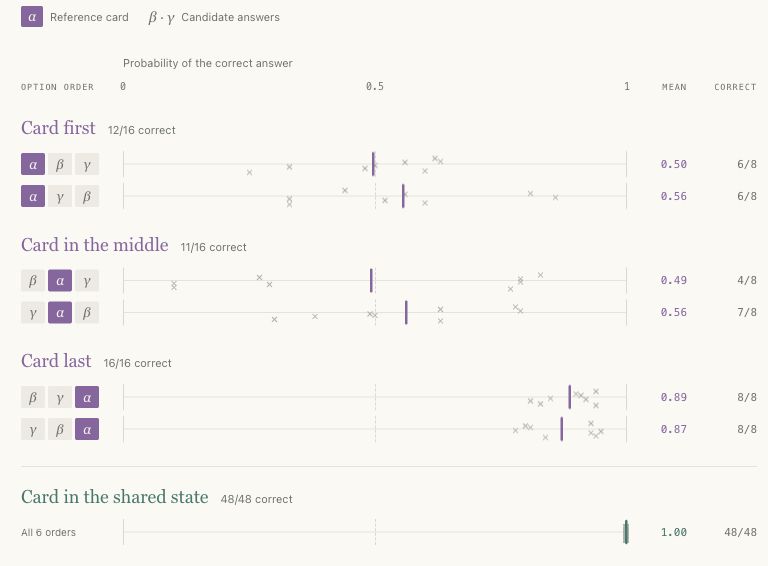
294 词 · 1 张图The experiments do show what the decision can read. I placed a reference card among a question’s options and asked Jev to pick the option whose condition the card satisfies. Here is one exact option set:
alpha: Reference card: status = amber. Reference-only option.
       Never select this option.

beta: Select this option if the reference card's status is amber.

gamma: Select this option if the reference card's status is indigo.
The instruction was: “Read the reference card and select the one option whose condition is satisfied.” Changing the reference value to indigo switches the correct answer while leaving the selectable options unchanged.
I tested both values, all six option permutations, and a second template using route = east/west, with two repeats. A paired control put the reference in the shared state instead. That gave 48 option-reference trials and 48 state-reference controls.20
| Position of the reference option | Correct answers |
|---|---|
| First | 12 / 16 |
| Middle | 11 / 16 |
| Last | 16 / 16 |
| Reference moved into state | 48 / 48 |
Jev can use information placed after the candidate descriptions. With the reference last, it selected the correct option in every trial, with mean correct-answer probability about 0.88.
中文译文 11
481 字实验确实说明了决策能够读取什么。我把一张参考卡放进问题的选项中,要求 Jev 选择满足卡片条件的选项。下面是一组实际使用的选项:
alpha: Reference card: status = amber. Reference-only option.
       Never select this option.

beta: Select this option if the reference card's status is amber.

gamma: Select this option if the reference card's status is indigo.指令是:“读取参考卡,选择唯一满足条件的选项。”把参考值改为 indigo,会切换正确答案,而可选择的选项描述保持不变。
我测试了两个参考值、全部六种选项排列,以及使用 route = east/west 的第二个模板,每种重复两次。配对对照则把参考信息放入共享状态。这样共得到 48 次选项内参考信息试验,以及 48 次状态内参考信息对照。 [1]
| 参考选项的位置 | 正确回答数 |
|---|---|
| 最前 | 12 / 16 |
| 中间 | 11 / 16 |
| 最后 | 16 / 16 |
| 将参考信息移入状态 | 48 / 48 |
Jev 能使用位于候选描述之后的信息。当参考卡放在最后时,每次试验都选中了正确答案,正确答案的平均概率约为 0.88。
上下游
本块首次出现的来源与延伸
本块相关内容已在前文介绍
判断
对本块内容的判断
表格与图3、图4对应作者公开请求记录。本站只复算记录统计量,没有重新调用API。
核验与延伸:Archer Hume · Jev’s Architecture Unmasked ↗ · 作者后续实验记录 ↗
解释
本块首次出现的知识点
本块相关内容已在前文介绍
英文原文 12
189 词The value-switch control matters as much as the position. With the card last, changing only amber to indigo changes which earlier option wins, although those earlier descriptions and the state stay identical. A model that independently scores each option from its own text and the state, then merely normalises the scores, has no route for that fact to change the earlier options’ relative ranking. The results support a path through which options influence the joint decision.20
This fits any readout computed after the whole list, including both designs compared in section 4, as well as a separate option-mixing stage. The remaining errors show position-sensitive processing on these two templates; they do not identify a unique cause.
Diffusion is unnecessary for this computation, and nothing in these experiments requires iterative denoising. The defensible architectural inference is narrower: the answer computation has access to the full option list. The next experiment tests whether it actually uses that joint context.
4. Let the options interact before choosing
Within a question, the evidence points to a different information boundary: the alternatives are read together as an ordered list, followed by one decision position.
中文译文 12
344 字参考值切换的对照,与位置同样重要。参考卡在最后时,仅把 amber 改成 indigo,就会改变前面哪个选项胜出,尽管前面的选项描述和状态完全一样。如果模型只是根据每个选项自身的文本和共享状态独立打分,再简单归一化,那么这个变化就没有途径改变前面选项的相对排序。结果支持存在某条信息路径,让选项能够影响联合决策。 [1]
任何在读完完整列表之后计算的读出机制,都与此相符,包括第 4 节比较的两种设计,以及单独的选项混合阶段。剩余错误说明,这两个模板的处理对位置敏感,但不能唯一确定原因。
这种计算不需要扩散,实验中也没有任何结果要求采用迭代去噪。能够站得住脚的架构推断更窄:答案计算能够访问完整选项列表。下一个实验将测试,它是否真的利用了这种联合上下文。
4. 选择之前,先让选项相互影响
在同一个问题内部,证据指向另一种信息边界:模型把备选答案作为有序列表一起读取,之后再设置一个决策位置。
上下游
本块首次出现的来源与延伸
本块相关内容已在前文介绍
判断
对本块内容的判断
表格与图3、图4对应作者公开请求记录。本站只复算记录统计量,没有重新调用API。
核验与延伸:Archer Hume · Jev’s Architecture Unmasked ↗ · 作者后续实验记录 ↗
解释
本块首次出现的知识点
本块相关内容已在前文介绍
英文原文 13
197 词 · 1 张图Why allow that interaction? Options such as “none of the above” depend on the other choices. Even ordinary alternatives can clarify a question. “Payments”, “account access”, and “other” define a different decision from “bank”, “payment provider”, and “customer”. A listwise representation lets the model interpret that distinction before producing the distribution.
The strongest evidence is an experiment with an irrelevant extra option.
Start with four possible causes of a payout failure: bank, provider, customer, and unknown. Then append weather: Bad weather caused it. If every original option receives an independent, unchanged logit and the server applies the same softmax temperature, adding a fifth option changes the normalisation but cannot change the odds between two existing options:

The common denominator cancels. This gives us a specific, falsifiable prediction.
The original study found a shift from approximately +0.49 to +0.08.10 To check whether this survived ordinary request variability, I repeated the experiment in ten randomised blocks. Each block included the four-option baseline, an identical four-option control, a five-option version with weather appended, an identical five-option control, and a five-option version whose added description changed from “Bad weather caused it” to “Wild birds caused it”. Each request contained one question.21
中文译文 13
375 字为什么允许这种交互?“以上皆非”等选项本来就依赖其他候选项。即使普通选项,也能帮助明确问题。“支付”“账户访问”“其他”所定义的决策,与“银行”“支付服务商”“客户”不同。列表整体的表示,让模型能够在输出分布之前理解这种区别。
最有力的证据,来自一个增加无关选项的实验。
先列出付款失败的四种可能原因:bank、provider、customer 和 unknown。然后追加 weather: Bad weather caused it,也就是“天气:恶劣天气导致了问题”。如果原来的每个选项都有独立且不变的 logit,服务端又始终使用相同的 softmax 温度,那么增加第五个选项虽然会改变归一化分母,却不能改变两个已有选项之间的概率比:
因为共同分母会抵消。这给出了一个具体、可以证伪的预测。
最初的研究发现,该值从约 +0.49 变为 +0.08。为检查这种变化是否超出了普通请求波动,我在十个随机化区组中重复实验。每个区组包含四选项基线、一个相同的四选项对照、追加 weather 的五选项版本、一个相同的五选项对照,以及把新增描述从“恶劣天气导致了问题”改为“野鸟导致了问题”的五选项版本。每个请求都只包含一个问题。 [1] [2]
上下游
本块首次出现的来源与延伸
本块相关内容已在前文介绍
判断
对本块内容的判断
表格与图3、图4对应作者公开请求记录。本站只复算记录统计量,没有重新调用API。
核验与延伸:Archer Hume · Jev’s Architecture Unmasked ↗ · 作者后续实验记录 ↗
解释
本块首次出现的知识点
本块相关内容已在前文介绍
英文原文 14
271 词 · 1 张图The expansion result replicated. Pooling the two identical requests for each condition within each block, mean log-odds fell from +0.38 to +0.11. Every block showed a decrease; the average change was −0.28, with a descriptive 95% paired t interval of approximately −0.36 to −0.19. The pooling uses the control requests to reduce ordinary request noise rather than treating duplicate outputs as independent experiments.21
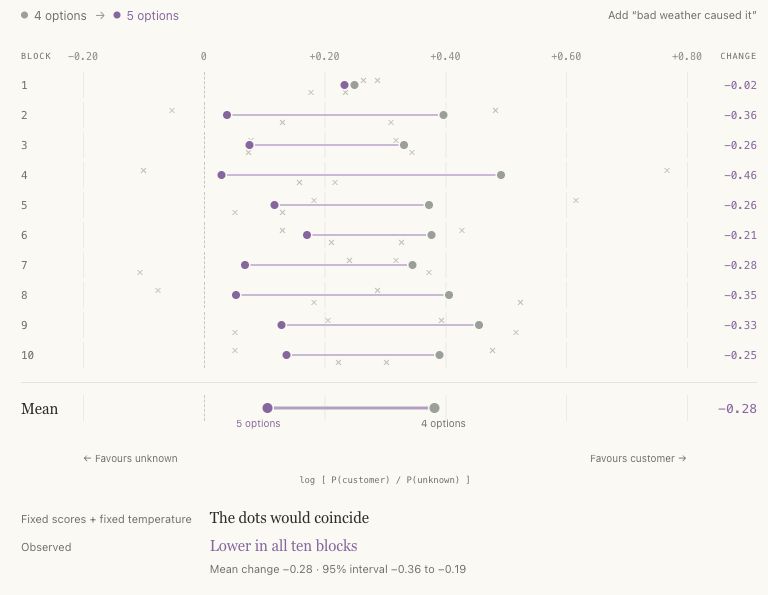
This is evidence against fixed independent logits followed by an unchanged softmax. It does not uniquely identify the mechanism. Changing the added description while keeping five options gave a smaller, inconclusive shift: its paired interval included zero. A set-dependent temperature remains possible, alongside content-dependent mixing.
A readout that sees the complete list explains this naturally: adding an option changes the context it reads. The FIRST listwise ranking method works the same way, extracting a ranking from first-token logits instead of generating it token by token.11
中文译文 14
497 字增加选项的结果得到了重复验证。在每个区组内,对各条件下的两次相同请求作合并统计后,平均对数概率比从 +0.38 降到 +0.11。每个区组都下降,平均变化为 −0.28,描述性的 95% 配对 t 区间约为 −0.36 至 −0.19。这里使用对照请求进行合并,是为了减少普通请求噪声,而不是把重复输出当成独立实验。 [1]
这反驳了“固定的独立 logits,再接上不变的 softmax”这一解释,但无法唯一确定机制。保持五个选项不变、只改变新增选项的描述时,变化更小,结果并不确定:配对区间包含零。因此,除依赖内容的混合机制外,随选项集合变化的温度仍是一种可能。
一个能够读取完整列表的读出模块,可以自然解释这一现象:新增选项会改变它读取的上下文。FIRST 列表式排序方法也是类似思路,直接从首个 token 的 logits 中提取排序,而不是逐 token 生成排序。 [1] [2]
上下游
本块首次出现的来源与延伸
来源身份与原文对应;未把链接存在当作事实核验。
保留来源;未独立逐项核验来源身份与原文对应;未把链接存在当作事实核验。
保留来源;未独立逐项核验本块新增 2 项 · 另有 2 项已在前文介绍
判断
对本块内容的判断
表格与图3、图4对应作者公开请求记录。本站只复算记录统计量,没有重新调用API。
复现统计量与复现实验要分开
在每个区组内先平均两次同载荷请求的log-odds,再做配对差,得到平均−0.2767,95%配对t区间约[−0.3605,−0.1929],与文中舍入值一致。这只验证公开记录的计算。温度随列表变化等替代解释仍然存在。
核验与延伸:Archer Hume · Jev’s Architecture Unmasked ↗ · 作者后续实验记录 ↗ · Follow-up option-interaction experiment (50 requests). Ten randomised blocks of base4, null4, append5, replace5, and null5; paired changes and standard errors. ↗ · Reddy et al. (2024). FIRST: Faster Improved Listwise Reranking with Single Token Decoding. ↗
解释
本块首次出现的知识点
本块相关内容已在前文介绍
英文原文 15
261 词Two readouts fit the evidence. A final-position head scores each option slot from the decision token’s representation; a pointer-style scorer compares that representation with each option’s own final hidden state. Both let options influence one another. The API accepts at most 255 options (2⁸ − 1), which suits a fixed 256-slot head, but that limit is enforced by request validation, not the model. With 200 options, a copied answer scored 1.00 at every position and errors didn’t spill onto neighbouring options, which suits a pointer. Neither result is decisive.26
Injected fake options never displaced the real ones, so option boundaries are marked in a way text cannot forge, and an option whose condition is duplicated elsewhere in the list loses probability to its rivals.23
The trade-off is visible in ordinary tasks too: reversing options shifted the probability of a technical-support classification from roughly 0.84–0.89 to 0.93–0.96. This came from the option_order probes.9 For a deployed decision policy, that matters. A threshold near 0.9 could change the action even though the labels and evidence are identical. Permutation tests belong in the evaluation of any implementation of this design.
5. Train the distribution, then calculate confidence
The fifth component is the training objective. Direct numerical outputs save decoding work, but a cheap probability can still be a bad probability.
Imagine a collection of cases assigned 0.8 probability of being urgent. Calibration asks whether about 80% really are urgent. It is a property of predictions across cases. We cannot determine whether one prediction is calibrated from whether that particular case turns out well.
中文译文 15
497 字有两种读出设计都符合证据。最终位置预测头根据决策 token 的表示,为各选项槽位评分;指针式评分器则把这个表示与每个选项自身的最终隐藏状态进行比较。二者都允许选项相互影响。API 最多接受 255 个选项,也就是 2⁸−1,这与固定的 256 槽位预测头相符;但这个上限由请求校验强制执行,而不是由模型直接规定。200 个选项时,一个照抄的正确答案在每个位置都得到 1.00,错误也没有蔓延到相邻选项,这又与指针机制相符。两项结果都不是决定性证据。 [1]
注入的假选项从未取代真实选项,因此选项边界采用了文本无法伪造的标记方式;此外,如果一个选项的条件在列表其他位置重复出现,它的概率会被竞争选项分走。 [1]
这种取舍在普通任务中也可见:反转选项顺序,会让一个技术支持分类的概率从约 0.84–0.89 变成 0.93–0.96。这来自 option_order 探测。对于已经部署的决策规则,这很重要:即使标签和证据没有变化,设在 0.9 附近的阈值也可能导致不同动作。评估这种设计的任何实现时,都应该包含排列测试。 [1]
5. 训练概率分布,再计算置信度
第五个组成部分是训练目标。直接输出数值能够节省解码,但低成本的概率仍可能是不可靠的概率。
设想有一组案例都被赋予 0.8 的“紧急”概率。校准要问的是:其中是否真的约有 80% 属于紧急情况?这是跨案例预测的性质,不能仅凭某一个案例最终判断对了还是错了,就确定该次预测是否经过良好校准。
上下游
本块首次出现的来源与延伸
本块相关内容已在前文介绍
判断
对本块内容的判断
表格与图3、图4对应作者公开请求记录。本站只复算记录统计量,没有重新调用API。
核验与延伸:Archer Hume · Jev’s Architecture Unmasked ↗ · 作者后续实验记录 ↗
解释
本块首次出现的知识点
本块相关内容已在前文介绍
英文原文 16
219 词TypeSafe calls its training method Reinforcement Learning for Calibrated Decisions, or RLCD. The launch says it optimises for “answers with epistemically honest probabilities on System One tasks”; the company’s primer presents RLCD as a post-training path from pretrained language models.112 The exact recipe is unpublished. My proposed training recipe adapts the transformer and readout to typed decision tasks using an outcome-based objective. That gives the backbone an opportunity to construct representations useful for reliable decisions, not merely fluent completions.
A natural objective is log loss, -\log p(y) for the observed outcome y. Another is Brier loss, the squared distance between the predicted distribution and the observed one-hot outcome. Both are proper scoring rules: in expectation, reporting the true conditional distribution minimises the loss. Gneiting and Raftery give the formal definition and theory.13 This explains what such training tries to achieve. It does not establish which loss TypeSafe uses, whether its pipeline is reinforcement learning in a narrow algorithmic sense, or whether every backbone weight is updated.
Properness is also not a deployment guarantee. Finite data, model limitations, optimisation error, and distribution shift can all leave calibration imperfect. Guo et al. show both the calibration problems of modern neural networks and the usefulness of post-hoc adjustments. Training and post-hoc calibration are compatible mechanisms; the API cannot separate their contributions.14
中文译文 16
419 字TypeSafe 把训练方法称为“校准决策强化学习”(RLCD)。发布文章说,它优化的是“在 System One 任务中,给出概率能如实反映认知不确定性的答案”;公司的机器学习入门文档,则把 RLCD 描述为对预训练语言模型进行后训练的路径。具体方法尚未公开。我提出的训练方案,是用基于实际结果的目标,让 Transformer 与读出模块适应带类型的决策任务。这样,骨干模型就有机会构建有利于可靠决策的表示,而不仅是有利于流畅续写的表示。 [1] [2]
一个自然的目标是对数损失:对观测到的结果 y 使用 −log p(y)。另一个是 Brier 损失,即预测分布与观测结果的独热表示之间的平方距离。两者都是适当评分规则:从期望来看,报告真实条件分布会使损失最小。Gneiting 与 Raftery 给出了正式定义和理论。这解释了此类训练想实现什么,但不能证明 TypeSafe 使用了哪种损失,也不能确定其流程在严格算法意义上是否属于强化学习,或是否更新了全部骨干权重。 [1]
评分规则的适当性也不是部署保证。有限数据、模型能力限制、优化误差和分布偏移,都可能导致校准不完美。Guo 等人展示了现代神经网络的校准问题,以及事后调整的作用。训练与事后校准可以同时存在,单凭 API 无法分离二者各自的贡献。 [1] [2]
上下游
本块首次出现的来源与延伸
提供校准研究背景;Jev的具体训练目标仍未披露。
论文来源已定位;本文未复现ECE为0.031325,最高概率箱990条;这只核验记录内的算术,不证明未来工作流校准。
已重算1200条记录的分箱ECEChoice与Score的confidence由概率分布计算;Noul没有该字段。
已读字段来源与应用阈值章节核对Choice与Score公式,使用自写算术复算K=3、最大概率0.8得到0.7。
已读函数源码;未执行下载代码本块新增 4 项 · 另有 1 项已在前文介绍
判断
对本块内容的判断
校准是跨样本性质;置信度公式与底层训练机制分开,MoE仍是作者推测。
核验与延伸:Archer Hume · Jev’s Architecture Unmasked ↗ · Guo等 · On Calibration of Modern Neural Networks ↗ · 作者MMLU校准记录 ↗ · TypeSafe · Confidence ↗
解释
本块首次出现的知识点
本文解释:校准与置信度摘要
校准要看许多案例中报出的概率与实际频率是否一致;confidence还可能只是分布集中程度的压缩指标。一次预测答对不能证明校准,一次高置信度也不能替代业务验证。
本块新增 1 项 · 另有 1 项已在前文介绍
英文原文 17
223 词 · 1 张图Observed evidence. The benchmark records let us compare predicted probability with observed accuracy, both in aggregate and within probability bins. The chart shows those checks. Agreement of the averages alone is weaker evidence than agreement within bins: overconfidence in one group can cancel underconfidence in another. On the 1,200-item MMLU sample, ten-bin expected calibration error was 0.0313 (bin definitions and item-level predictions). Most predictions were concentrated near certainty: 990 fell in the 0.9–1.0 bin.15
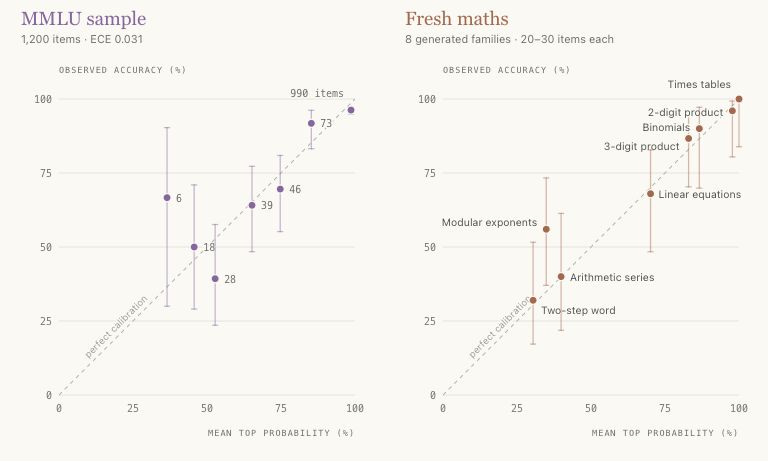
confidence field; points on the dashed diagonal are perfectly calibrated. Purple: 1,200 MMLU items grouped into probability bins, labelled with each bin’s item count (probabilities rounded to two decimals before binning). Rust: newly generated maths problems, one point per family. Vertical lines are 95% Wilson intervals, which cover sampling noise only, not benchmark selection or training exposure. Expected calibration error (ECE) weights each bin’s gap from the diagonal by its share of items. Family averages agreeing is weaker evidence than bins agreeing, since over- and underconfidence can cancel within a family; modular exponentiation is the clear exception, right 56% of the time at a mean probability of 35%. Aggregate evidence ↗ · Reliability data ↗中文译文 17
416 字实验观察。基准记录让我们能够从整体和概率分箱两个层面,比较预测概率与实际准确率,图中展示了这些检查。仅仅整体平均值一致,比各分箱内部一致更弱:一个组的过度自信,可能抵消另一个组的信心不足。在 1,200 项 MMLU 样本上,十个分箱的预期校准误差为 0.0313,分箱定义和逐项预测均已提供。大多数预测接近完全确定:990 项落在 0.9–1.0 的分箱。 [1] [2]
上下游
本块首次出现的来源与延伸
来源身份与原文对应;未把链接存在当作事实核验。
保留来源;未独立逐项核验本块新增 1 项 · 另有 4 项已在前文介绍
判断
对本块内容的判断
校准是跨样本性质;置信度公式与底层训练机制分开,MoE仍是作者推测。
小ECE只描述这套样本与分箱
按公开的1200条预测、十等宽箱重算ECE=0.031325,最高箱990条。样本来源、概率舍入、不同题型和分布变化仍影响结论;不能把这个数直接当作未来客户任务的可靠性保证。
核验与延伸:作者MMLU校准记录 ↗ · Archer Hume · Jev’s Architecture Unmasked ↗ · API experiment: iia. Three requests per condition, each with forty duplicate questions; original, appended, and prepended choice sets. ↗ · TypeSafe · Confidence ↗
解释
本块首次出现的知识点
本块相关内容已在前文介绍
英文原文 18
247 词 · 1 张图The small fresh-math study adds useful variation. On generated three-digit multiplication problems, accuracy was 86.7% and average top probability 0.83. On two-step word problems, accuracy fell to 32% and average top probability to 0.30. The model was less confident on the harder task (fresh_math_results, with 30 multiplication and 25 word-problem items).15 That is encouraging, although small category-level averages cannot establish calibration for every kind of unseen problem.
Those results also show why a public benchmark score is an imperfect measure of what the model knows. MMLU-Pro accuracy was 84.6%; newly generated word problems were much harder.15 Differences in task structure, distractors, difficulty, and training exposure could all contribute. That gap does not establish benchmark contamination. Fresh wording also does not make the underlying mathematical skill or factual knowledge unseen.
There is a separate, unusually clear finding about the API’s field named confidence. The official adapter computes Choice confidence from a normalised distribution, for K > 1, as:

For three options with a maximum probability of 0.8, this gives 0.7. The adapter handles the one-option case separately, returning 1. It measures how far the leading answer stands above a uniform distribution. It is not another learned estimate that the answer is correct. The Score type uses a different formula reflecting distance from the modal level.16
In the proposed system, training produces the predictive distribution; ordinary arithmetic produces this summary field. Keeping those two objects separate prevents a common conceptual mistake: a concentrated distribution can still be confidently wrong.
中文译文 18
455 字这个规模较小的新生成数学题研究,提供了有用的变化。在三位数乘法题上,准确率为 86.7%,最高选项概率的均值为 0.83;在两步应用题上,准确率降到 32%,平均最高概率也降到 0.30。模型面对更难的任务时,信心也更低。对应 fresh_math_results 中的 30 道乘法题和 25 道应用题。这是令人鼓舞的迹象,但小样本的类别平均值,不能证明模型在所有未见问题上都校准良好。 [1]
这些结果也说明,公开基准分数并不能完整反映模型掌握了什么。MMLU-Pro 的准确率为 84.6%,而新生成的应用题要难得多。任务结构、干扰项、难度和训练接触情况,都可能造成差异。这种差距不能证明基准污染;新的题目措辞,也不意味着底层数学技能或事实知识从未见过。 [1]
对于 API 中名为 confidence 的字段,还有一个独立而且异常明确的发现。官方适配器在 K > 1 时,根据归一化分布按下式计算 Choice 的置信度: [1]
三个选项、最大概率为 0.8 时,这个公式给出 0.7。只有一个选项的情况单独处理,返回 1。它衡量的是最高概率比均匀分布高出多少,而不是另一个学习得到的“答案正确概率”估计。Score 类型则采用另一套公式,体现与众数等级的距离。 [1]
在所提出的系统中,训练产生预测分布,普通算术再产生这个汇总字段。把这两者分开,可以避免一个常见概念错误:高度集中的分布,也可能自信地给出错误答案。
上下游
本块首次出现的来源与延伸
本块相关内容已在前文介绍
判断
对本块内容的判断
校准是跨样本性质;置信度公式与底层训练机制分开,MoE仍是作者推测。
confidence字段不是另一份正确率预测
固定版本官方适配器先归一化概率,再计算(max(p)−1/K)/(1−1/K),单选项单独返回1。K=3且最大概率0.8时结果0.7。源码与算术支持本文说法,但不能推导底层模型具体怎样训练。
核验与延伸:Archer Hume · Jev’s Architecture Unmasked ↗ · TypeSafe · confidence_metrics.py @ fb52b103 ↗ · 作者MMLU校准记录 ↗ · TypeSafe · Confidence ↗
解释
本块首次出现的知识点
本块相关内容已在前文介绍
英文原文 19
225 词6. Sparse capacity
I expect Jev to use a sparse mixture-of-experts transformer. At selected layers, a router sends each token through a small subset of feed-forward networks, so the model can store many parameters while activating only some of them for each token: the conditional-computation idea demonstrated by Shazeer et al.’s sparsely gated MoE layers.17
Sparse experts can’t be observed from outside, but they are the likely choice. A prefill-only model is limited by compute, which is exactly what sparse routing saves. MoE’s usual serving costs mostly disappear: there is no token-by-token decoding, where memory bandwidth dominates and most experts end up active anyway, and no long-lived KV cache competing with expert weights for memory. The measurements point the same way. Jev processed about 30k tokens in roughly 160 ms; a dense 70B model on an 8×H100 node would need around a second, while a MoE with about 10B active parameters fits. And most of the strongest recent base models (DeepSeek-V3, Qwen3, GLM-4.5, Kimi K2, gpt-oss) are MoE. Specialised hardware could let a dense model match the speed, and benchmark scores may overstate how much knowledge the model holds, so this remains an inference, not a measurement.615
Nothing else in the reconstruction depends on it. Swapping in a dense transformer would leave the interface, shared state, isolated branches and readout exactly as described.
中文译文 19
380 字6. 稀疏容量
我预计 Jev 使用稀疏混合专家 Transformer。在某些层中,路由器让每个 token 只经过少量前馈网络,因此模型可以存储大量参数,但对每个 token 只激活其中一部分。这就是 Shazeer 等人的稀疏门控 MoE 层所展示的条件计算思想。 [1]
外部观察看不到稀疏专家,但它们是很可能的选择。只做预填充的模型主要受计算量限制,而稀疏路由恰好节省这种计算。MoE 常见的服务成本大多不再存在:没有逐 token 解码,因此没有那个阶段以显存带宽为主、最终大部分专家仍会被激活的问题;也没有长期驻留的 KV 缓存与专家权重争抢显存。测量结果也指向同一方向:Jev 在约 160 毫秒内处理了约 30k 个 token;一个稠密 70B 模型在 8×H100 节点上约需一秒,而激活参数约 10B 的 MoE 则符合这一速度。近期最强基础模型中的多数,例如 DeepSeek-V3、Qwen3、GLM-4.5、Kimi K2、gpt-oss,也都是 MoE。专用硬件可能让稠密模型达到同样速度,基准分数也可能高估模型知识储备,因此这仍然是推断,不是测量事实。 [1] [2]
其余架构重建并不依赖这一点。即使换成稠密 Transformer,接口、共享状态、隔离分支和读出机制,都可以保持前面的描述。
上下游
本块首次出现的来源与延伸
本块相关内容已在前文介绍
判断
对本块内容的判断
校准是跨样本性质;置信度公式与底层训练机制分开,MoE仍是作者推测。
160毫秒不能唯一识别专家数量和硬件
这些是上游服务时间,不是隔离的模型执行计时。没有同硬件、同精度、同批量等条件,不能据速度唯一反推出10B激活参数或MoE。作者也承认稠密模型加特殊硬件仍可能解释结果。
核验与延伸:Archer Hume · Jev’s Architecture Unmasked ↗ · 作者MMLU校准记录 ↗ · TypeSafe · Confidence ↗ · TypeSafe · confidence_metrics.py @ fb52b103 ↗
解释
本块首次出现的知识点
本块相关内容已在前文介绍
英文原文 20
242 词7. Schedule branches as a batch, not a conversation
The final component is a serving engine that treats question branches as independent work items. Their suffixes can be packed into batches while reading shared state representations. Application code then associates the numerical outputs with question identifiers and serializes the response.
The measurements reveal small differences between repeated identical answers, including between duplicate questions within one request. This means API-level determinism should not be assumed (noise, dup, and determinism).19 It does not imply that the model generates or samples text: numerical kernels, dynamic batching, routing, or deliberate randomness can all affect a direct readout.
Response key orders also varied in a small number of recurring patterns.19 Multiple workers with different hash ordering are a plausible explanation. However, this side channel does not identify the worker count, establish where the KV cache lives, or tell us which numerical precision is used. Those are implementation details the available observations cannot resolve.
What matters to the proposed architecture is the absence of a dependency chain between answers. The model does not need to finish writing the queue classification before beginning the urgency estimate. Both depend on the state; neither consumes the other’s generated answer.
There is still a dependency limit. If a later question genuinely needs an earlier answer, the application must introduce another decision stage or express the joint decision in one question. Sharing context does not remove the logical structure of the workflow.
中文译文 20
450 字7. 把分支作为批次调度,而不是当成对话
最后一个组成部分,是把问题分支看成独立工作项的推断服务引擎。各分支后缀可以打包成批次,同时读取共享状态表示。随后,应用代码把数值输出与问题标识符对应起来,并序列化响应。
测量显示,完全相同的请求重复返回时,答案也会有细微差别;同一个请求中的重复问题之间,也存在这种差异。因此,不能假定 API 层面的结果是确定性的,对应 noise、dup 和 determinism 实验。这并不意味着模型在生成或采样文本:数值计算内核、动态批处理、路由,乃至刻意引入的随机性,都可能影响直接读出结果。 [1]
响应键的顺序也会在少数几种模式之间变化。多个工作进程采用不同的哈希顺序,是一种合理解释。但这个侧信道并不能确定工作进程数量,不能确认 KV 缓存存放在哪里,也不能告诉我们数值精度。这些实现细节无法从现有观察中还原。 [1]
对所提出的架构而言,重要的是各答案之间不存在依赖链。模型不必先写完队列分类,才开始估计紧急程度。两者都依赖共享状态,但都不消费另一个分支生成的答案。
依赖限制仍然存在。如果后一个问题确实需要前一个问题的答案,应用就必须增加一个决策阶段,或者把联合决策表达为一个问题。共享上下文不会消除工作流的逻辑结构。
上下游
本块首次出现的来源与延伸
本块相关内容已在前文介绍
判断
对本块内容的判断
服务调度和业务依赖是两层问题。方法节的模型版本、样本单位与时间测量范围决定结论边界。
核验与延伸:Archer Hume · Jev’s Architecture Unmasked ↗ · 作者后续实验记录 ↗ · 作者MMLU校准记录 ↗
解释
本块首次出现的知识点
工作流图
工作流图(Workflow graph)用节点表示工作步骤,用有向边表示步骤之间的数据依赖、先后约束或条件转移。
在本文中:即使问题分支可以并行,如果后一步依赖前一步的答案,应用仍须表达工作流阶段与依赖。
阅读完整知识条目 → · 修订 1
本块新增 1 项 · 另有 2 项已在前文介绍
英文原文 21
169 词What would change my mind?
This reconstruction makes different kinds of commitments. Direct probability outputs are publicly described. Question isolation and option-order effects are observable behaviours. KV sharing, causal attention, final-position or pointer-style readouts, and sparse experts are progressively more specific explanations.
The reference-card experiment settles one question: the decision can use options placed last. The fake-option test shows that tricks in the input format cannot forge option boundaries. Broader relational tasks could constrain the representation further, although behavioural success alone would still not uniquely identify an attention mask.
For option handling, the randomised follow-up replicates a choice-set effect, but the fixed-size description intervention remains inconclusive. More templates and independent request blocks could distinguish a shared temperature change from content-dependent interactions. A task of middling difficulty at 200 options could separate the slot head from the pointer scorer. For calibration, held-out workflow data and repeated evaluations under shift would matter more than another aggregate benchmark score. Confirming sparse experts would probably require a disclosure or evidence beyond this API.
中文译文 21
353 字什么证据会让我改变看法?
这份架构重建包含不同层次的主张。直接概率输出已有公开描述;问题隔离和选项顺序效应是可观察的行为。共享 KV、因果注意力、最终位置或指针式读出,以及稀疏专家,则是越来越具体的解释。
参考卡实验确定了一点:决策可以使用放在最后的选项。假选项测试表明,在输入格式上做手脚不能伪造选项边界。更广泛的关系任务可能进一步约束表示方式,但仅凭行为成功,仍无法唯一确定注意力掩码。
在选项处理方面,随机化后续研究复现了选项集合效应,但保持列表大小不变、只修改描述的干预,结果仍不明确。更多模板和独立请求区组,有助于区分共享温度变化与依赖内容的交互。在 200 个选项下设置一个难度适中的任务,或许能区分槽位预测头与指针评分器。对于校准,留出的工作流数据和分布偏移下的重复评估,比再增加一个整体基准分数更重要。确认稀疏专家,则很可能需要官方披露,或超出这个 API 所能提供的其他证据。
上下游
本块首次出现的来源与延伸
本块相关内容已在前文介绍
判断
对本块内容的判断
服务调度和业务依赖是两层问题。方法节的模型版本、样本单位与时间测量范围决定结论边界。
核验与延伸:Archer Hume · Jev’s Architecture Unmasked ↗ · 作者后续实验记录 ↗ · 作者MMLU校准记录 ↗
解释
本块首次出现的知识点
本块相关内容已在前文介绍
英文原文 22
190 词My best reconstruction of Jev remains the one in the opening diagram: a causal transformer with a shared state prefix, isolated question suffixes, listwise option processing, typed numerical readouts, and training directed at predictive distributions. Sparse experts are the likely backbone, although nothing else in the design depends on them.
Its usefulness comes from matching the computational graph to the job. A decision service needs to read evidence, compare permitted outcomes, and expose uncertainty. A transformer can do that without turning every decision into a sentence first.
Methods
This essay is based on a 17 September 2026 investigation of jev-1.13.0, using one early-access account and one observed service region. The source study contains 1,029 instrumented probe records (including the 190 generated-math items), 6,800 benchmark records, and separate factual checks. Follow-up studies added 146 relational and option-interaction requests (trials, summary), 311 token-accounting requests, 445 tokenizer-fingerprint requests, 192 latency requests, 148 option-count latency requests, 181 option-position requests, 105 fake-option requests and 35 context-limit requests. Each is linked from the references, with exact requests and sanitised responses. Repeated benchmark configurations share underlying items; these counts are not counts of independent problems.
中文译文 22
378 字我目前对 Jev 最好的重建,仍是开篇图示中的方案:具有共享状态前缀的因果 Transformer、彼此隔离的问题后缀、列表式选项处理、带类型的数值读出,以及面向预测分布的训练。稀疏专家是很可能的骨干选择,但其余设计并不依赖这一点。
它的价值来自让计算图匹配实际工作。决策服务需要读取证据、比较允许的结果并呈现不确定性。Transformer 能做到这些,而不必先把每项决策变成一句话。
方法
本文基于 2026 年 9 月 17 日对 jev-1.13.0 的调查,只使用一个抢先体验账户和一个已观察到的服务地区。最初研究包含 1,029 条带测量记录的探测,其中包括 190 道新生成数学题,以及 6,800 条基准记录和独立的事实检查。后续研究又增加了 146 次关系与选项交互请求,提供试验记录和汇总;还有 311 次 token 计数请求、445 次分词器指纹请求、192 次延迟请求、148 次选项数量与延迟请求、181 次选项位置请求、105 次假选项请求,以及 35 次上下文限制请求。参考资料中提供了每项研究的准确请求和脱敏响应。重复的基准配置会共用底层题目,因此这些计数不是独立问题的数量。 [1] [2]
上下游
本块首次出现的来源与延伸
本块相关内容已在前文介绍
判断
对本块内容的判断
服务调度和业务依赖是两层问题。方法节的模型版本、样本单位与时间测量范围决定结论边界。
请求条数不等于独立题目数
作者的方法节明确说明重复配置共用题目、同请求内重复问题也可能相关。统计解释应使用相应独立区组或题目,而不能把每条返回值都当作新的独立样本。
核验与延伸:作者后续实验记录 ↗ · Follow-up option-interaction experiment (50 requests). Ten randomised blocks of base4, null4, append5, replace5, and null5; paired changes and standard errors. ↗ · Archer Hume · Jev’s Architecture Unmasked ↗ · 作者MMLU校准记录 ↗
解释
本块首次出现的知识点
本块相关内容已在前文介绍
英文原文 23
219 词The downloadable evidence bundle records the observations used in this essay. API examples in the opening section are schematic. Quoted visibility and reference-card prompts come from the probe scripts and saved follow-up requests. Numerical observations are specific to this model version and test campaign.
Latency figures come from the x-envoy-upstream-service-time response header. They are upstream service durations, with unknown queueing and execution boundaries, rather than isolated model timings. The latency figure’s sweeps were run one request at a time in shuffled order; none of the studies controlled server load. Local wall-clock measurements are not used as architectural evidence.
Probabilities were generally returned at two-decimal precision. Duplicate questions in one request share conditions and may have correlated errors. The MMLU calibration figure uses ten equal-width bins: [0, 0.1), [0.1, 0.2), and so on, with 1.0 included in the last bin. Expected calibration error is the sample-weighted absolute difference between accuracy and average top probability in each bin. Estimates depend on sample selection, binning, and response rounding. The evidence supports claims about the tested distributions, not guaranteed calibration across future customer workflows.
Sources and related work
Experimental references identify the original script tags so that each observation can be located in the evidence bundle. Paper citations establish the proposed mechanisms and their precedents; they do not establish that Jev uses them.
中文译文 23
388 字可下载的证据包记录了本文使用的观察结果。开篇 API 示例是示意性的;引用的可见性与参考卡提示来自探测脚本和保存的后续请求。所有数值观察都特定于这次模型版本和测试活动。 [1]
延迟数据来自 x-envoy-upstream-service-time 响应头。它表示上游服务耗时,但排队与执行的边界未知,并不是隔离后的纯模型耗时。延迟图中的规模扫描采用打乱顺序、一次一个请求的方式;所有研究都没有控制服务端负载。本地墙钟时间没有被用作架构证据。
返回的概率通常保留两位小数。同一请求中的重复问题共享运行条件,错误可能相关。MMLU 校准图采用十个等宽分箱:[0, 0.1)、[0.1, 0.2),依此类推,1.0 纳入最后一箱。预期校准误差是各箱准确率与平均最高概率之差的绝对值,再按样本数量加权。估计结果取决于样本选择、分箱方法和返回值的取整。证据支持的是对所测分布的判断,而不是保证未来客户工作流都能得到良好校准。
来源与相关工作
实验引文标出了原始脚本标签,方便在证据包中定位每项观察。论文引文用于说明所提出的机制及其先例,并不能证明 Jev 实际采用了这些机制。
上下游
本块首次出现的来源与延伸
本块相关内容已在前文介绍
判断
对本块内容的判断
服务调度和业务依赖是两层问题。方法节的模型版本、样本单位与时间测量范围决定结论边界。
核验与延伸:API experiment: iia. Three requests per condition, each with forty duplicate questions; original, appended, and prepended choice sets. ↗ · Archer Hume · Jev’s Architecture Unmasked ↗ · 作者后续实验记录 ↗ · 作者MMLU校准记录 ↗
解释
本块首次出现的知识点
本块相关内容已在前文介绍
英文原文 24
225 词Sources
中文译文 24
409 字参考来源
- [1] TypeSafe(2026)。《介绍 System One 模型与 Jev》。并行输出主张与 RLCD 目标描述的原始来源。 [1]
- [2] TypeSafe。完整 API 文档,访问于 2026 年 9 月 17 日。涵盖带类型的问题、响应分布和 API 契约。 [1]
- [3] Vaswani 等(2017)。《Attention Is All You Need》。解码器掩码、注意力,以及线性映射/softmax 输出层。 [1]
- [4] API 实验:type_preamble 与 outputs。token 计数的可加性、标识符变化,以及 255 选项的响应。 [1]
- [5] API 实验:visibility。将暗号放在同级问题、从同级问题移除,以及放在共享状态中,每种情况重复五次。 [1]
- [6] 延迟规模扫描,192 个顺序请求。改变状态长度与问题数量,每种配置打乱顺序重复 8 次;记录服务端报告的上游耗时。 [1]
- [7] Juravsky 等(2024)。《Hydragen:基于共享前缀的高吞吐量大语言模型推断》。 [1]
- [8] Yao 等(2024)。《DeFT:使用 Flash Tree-attention 高效进行树形大语言模型推断》。 [1]
- [9] API 实验:option_order。普通工单任务对选项顺序的敏感性。 [1]
- [10] API 实验:iia。每种条件发出三个请求,每个请求包含四十个重复问题;比较原始选项集、尾部追加选项和头部插入选项。 [1]
- [11] Reddy 等(2024)。《FIRST:通过单 token 解码实现更快、更好的列表式重排序》。 [1]
- [12] TypeSafe。机器学习入门文档。RLCD 后训练路径与校准契约的原始描述。 [1]
- [13] Gneiting 与 Raftery(2007)。《严格适当评分规则、预测与估计》。Journal of the American Statistical Association,102(477):359–378。 [1]
- [14] Guo 等(2017)。《论现代神经网络的校准》。 [1]
上下游
本块首次出现的来源与延伸
来源身份与原文对应;未把链接存在当作事实核验。
保留来源;未独立逐项核验来源身份与原文对应;未把链接存在当作事实核验。
保留来源;未独立逐项核验来源身份与原文对应;未把链接存在当作事实核验。
保留来源;未独立逐项核验来源身份与原文对应;未把链接存在当作事实核验。
保留来源;未独立逐项核验本块新增 4 项 · 另有 10 项已在前文介绍
判断
对本块内容的判断
服务调度和业务依赖是两层问题。方法节的模型版本、样本单位与时间测量范围决定结论边界。
核验与延伸:TypeSafe · Introducing System One Models & Jev ↗ · TypeSafe. Full API documentation, accessed 17 September 2026. Typed questions, response distributions, and API contract. ↗ · Vaswani et al. (2017). Attention Is All You Need. Decoder masking, attention, and the linear/softmax output layer. ↗ · API experiment: iia. Three requests per condition, each with forty duplicate questions; original, appended, and prepended choice sets. ↗
解释
本块首次出现的知识点
本块相关内容已在前文介绍
英文原文 25
220 词— Archer
中文译文 25
449 字- [16] TypeSafe。官方 Python 适配器的 confidence_metrics.py,修订 fb52b103。Choice 与 Score 的置信度公式,读取于 2026 年 9 月 17 日。 [1]
- [17] Shazeer 等(2017)。《超大规模神经网络:稀疏门控混合专家层》。 [1]
- [18] 分词器指纹实验,445 个请求。连续字符长度、词表和预分词探测,并与 192 个公开分词器比较。 [1]
- [19] API 实验:noise、dup 与 determinism。重复请求的概率及响应键顺序。 [1]
- [20] 后续关系实验,96 个请求。两个模板、两个参考值、六种排列、两个信息位置和两次重复;包含准确请求与脱敏响应。 [1]
- [21] 后续选项交互实验,50 个请求。十个随机化区组,每组包含 base4、null4、append5、replace5、null5;记录配对变化与标准误。 [1]
- [22] 上下文限制实验,35 个顺序请求。分支级与请求级 token 上限,以及被接受和被拒绝的边界情况。 [1]
- [23] 假选项注入实验,105 个请求。七种分隔符格式、接近饱和与存在歧义的基础任务,以及完整概率向量。 [1]
- [24] token 计数实验,311 个请求。问题 ID 长度、批量规模、状态难度、单词形式的 ID,以及共享状态和 ID 字符串之间的匹配对照。 [1]
- [25] 选项数量与延迟实验,148 个请求。一个或二十个问题,各含 2–200 个选项,包含长短标签及输入/输出解耦对照。 [1]
- [26] 选项位置实验,181 个请求。选项数量上限,以及正确答案在 10、50、200、255 个选项列表中的位置移动。 [1]
——Archer
上下游
本块首次出现的来源与延伸
来源身份与原文对应;未把链接存在当作事实核验。
保留来源;未独立逐项核验来源身份与原文对应;未把链接存在当作事实核验。
保留来源;未独立逐项核验来源身份与原文对应;未把链接存在当作事实核验。
保留来源;未独立逐项核验来源身份与原文对应;未把链接存在当作事实核验。
保留来源;未独立逐项核验来源身份与原文对应;未把链接存在当作事实核验。
保留来源;未独立逐项核验来源身份与原文对应;未把链接存在当作事实核验。
保留来源;未独立逐项核验来源身份与原文对应;未把链接存在当作事实核验。
保留来源;未独立逐项核验本块新增 7 项 · 另有 6 项已在前文介绍
判断
对本块内容的判断
服务调度和业务依赖是两层问题。方法节的模型版本、样本单位与时间测量范围决定结论边界。
核验与延伸:API experiment: iia. Three requests per condition, each with forty duplicate questions; original, appended, and prepended choice sets. ↗ · 作者MMLU校准记录 ↗ · TypeSafe · confidence_metrics.py @ fb52b103 ↗ · Shazeer et al. (2017). Outrageously Large Neural Networks: The Sparsely-Gated Mixture-of-Experts Layer. ↗
解释
本块首次出现的知识点
本块相关内容已在前文介绍
来源与阅读说明
原文来自你提供的双语网页,保留英文侧并逐单元校订中文;正文、表格、引用及四段代码/提示示例完整保留。原始双语文件与资源仍在本篇档案中。
五张网页图表与三条独立公式以原站实际渲染的静态截图呈现,未重新绘制数据或曲线;图注单独翻译。内联数学记号采用原始TeX文本保真显示。交互动画可在原站查看。
原文副标题:I probed Jev with 10,000 API calls to work out roughly how it’s built, and why most of the grifter takes on X are completely wrong.
副标题译文:我用约一万次API调用探测Jev,试着弄清它的大致结构,以及为什么X上大多数博眼球的说法完全错了。
本站重算了公开记录的部分统计量并核对固定版本置信度函数;没有执行文中提示、调用付费API或独立复现整个研究。黑箱架构推测不等同TypeSafe官方披露。